Monday, April 20, 2015

Should ALL Educators Be Innovative?


For the last few days I've been thinking about the definition of innovation and the place it has in education. I may be an EdTech person but I'm a "wordie" as well. I believe in the importance of words used well. It's why I feel adamant in choosing the words "facilitator" or "coach" over "para-pro," and "lead" over "master." It's why I dislike the word "rigor" and get so livid when I hear the word "fart" that I write blog posts about it. I need a definition to a word that I can wrap my head around and I need to know what it means to others. In education, you hear the term "buzz word" a lot. "Innovation" is the latest buzz word or "fail forward" or "personalized learning." I'll admit, I've reacted strongly against some words but often it's because my definition does not match that of the speakers. Being a wordie is probably why I like to blog as well.

So today's word in question is INNOVATION and it's place in education. At a meeting I was in last friday with educators and computer programmers a comment was made that "innovators find each other." It got me thinking...what is an "innovator?" So I pulled up the definition that said, "1: the introduction of something new. 2: a new idea, method, device" and in my head, it became the place where passion and need intersect. I have been accused of being a passionate educator on several occasions, and quite frankly I take it as a compliment (I'm not sure it is always meant that way). Because I am an instructional technologist, I think about how technology can aid the path of learning far more than I should. I stand firm in my belief that technology in the classroom can revolutionize the way students learn. I passionately try to convince the naysayers and I dig deep to find ways to prove the worth. What I enjoy the most is when I see a need and get the opportunity to look for ways to meet that need with technology. Like the figure above- when my passion for EdTech meets the needs of students, innovation occurs often. 

Does innovation have to be technology based? I don't think so. Technology doesn't have to be the only option of meeting a student's needs. Perhaps it means teaching a student how to take efficient notes by training them in some way using both visual drawings and words to stir remembrances. In that case, technology doesn't have to be a part of the equation. (Did you see how open minded I was with that idea just then?). What I do believe is that innovation works with an overarching cover of creativity. I believe innovators are creative souls. I believe the passions they have for their disciplines lead them to creatively think about how to best reach their students. I do not believe innovation and creativity can be separated. I do believe even non-creative types can see the benefit of innovation and want to use it. I do not believe non-creative types will be the ones that have that lightbulb moment of "Heyyyyyyy, what if we could make this happen!"

So what does this theory I have mean to education? When we place people in roles, I think it is important to decide what the level of innovative thinking needs to be for the job at hand. Are innovators also design thinkers? Perhaps this is also true. Are innovators risk takers? I think that is probably the case as well. So as educators, what positions require this type of personality and what positions don't? Is there a difference? Should there be a balance? Should ALL educators be innovative? I leave you with questions that I choose not to answer but would love to hear the thoughts of others. "Hmmmm moments" are some of my favorite to ruminate over. This is mine for today. 


Saturday, April 18, 2015

The Beauty of Collaboration

After 3 FULL days of mapping, planning, and strategizing with 3 different groups of educators (administration, technology, and math teachers) from 3 different schools within 3 different areas of the United States, I can tell you that the Three-cubed prototype project was amazing. Every single day of my life I connect with my twitter PLN to become a better educator and I truly find great value in that. I also found great value in meeting with like-minded individuals to work towards a solution for the common good of Christian education.

As we walked into this meeting, the majority of us had met one other time, over a couple of days for a few hours, so to say there wasn't a huge "connection" between the different schools would be a fair assumption. After a day and a half of some really good "give and take" safe discussions we broke up into groups to create a "lesson plan" using some math standards. My group consisted of a principal from Sioux Falls, South Dakota, myself as an instructional technologist from Chattanooga, Tennessee and a math teacher from Chattanooga as well.

We went right into prep mode looking at our standards we had been assigned. Immediately the math teacher had ideas on what she would want to do. The administration looked at it from what are the different modalities we could use in order to reach the most learning styles and he started aligning the standards being reached based on the choices we started brainstorming. I, of course, started looking at what technology could enhance the learning objectives that could also be standard aligned. In a matter or 30 minutes of thinking and rethinking, asking each other questions and seeing the math teacher as the true authority of the group, we had a blended learning lesson that felt right with a prior night flipped video for a hook.

It felt good to talk it out amongst ourselves. To share ideas when we each got stuck on a certain point. To reiterate the value of certain objectives when it got lost in the discussion. To search for helpful alternatives for each modality. To share our concerns over things that had the potential to cause a bottleneck. To share our excitement on things that certainly would cause certain students to have a better chance at learning well. It was the beauty of collaboration. A collaborative opportunity that worked so well it felt like perfection. Maybe it was because we had spent so much time together pushing ourselves to think outside the box and to be open to new ideas. Maybe it was because we had been forced to think creatively for a while. Maybe it was because we were all invested in the concept and were ready to "see" it in action. Regardless of the why's, it was a lovely moment.

You know those kind of moments, I have had several as an educator: Like the time the third grader that had never spoken out loud in class that I had taught since kindergarten raised her hand and answered a question, or the time that a co-teacher told me "I don't fear technology, your encouragement has made me brave to try new things and with your help, I see the value of this tool in my classroom.", or when I walk into the classroom as a tech coach and a student looks up and sees me and starts clapping because he's so excited to get to use technology, or my all time favorite is when a parent comes to me concerned about technology use in the elementary school and leaves saying "you've opened my eyes, my student is fortunate to have you as an instructor." We have those moments that make us go "YES!" The last three days were like that for me. I love innovation, I love collaboration. I believe that iron sharpens iron. These days included all those things. If I could do that type of thing every single day and throw in some student interaction as well, I would be walking on clouds professionally speaking.

As a rule, the teaching profession has been silo-centered...teachers have plugged away in their classroom with 20-30 students with little accountability, being the sole authority, with no resources beyond the 20-30 minutes they MIGHT get for lunch and a brief planning period on some days that they choose to seek out if they want to. Administration tries to develop meaningful professional development as best they can within that as well. But times are changing- educators are seeing more support staff in their classrooms and they are being evaluated as they teach more often. I saw a quote today that made me smile-- it says "If we create a culture where every teacher believes they need to improve, not because they are not good enough, but because they can be even better, there is no limit to what we can achieve." - Dylan Wiliam (University of London). I am a believer in this. I continue to seek out ways to collaborate for the greater good of the students that I teach. I have a strong desire to be a lifelong learner and never grow stagnant and "happy" with my teaching ability. I love thinking beyond "how does this affect my students" and looking at a broader picture. These last 3 days have just solidified that within me more and more. Thankful hearted today.

Tuesday, April 14, 2015

Meerkat & Periscope VERSUS "The Mom"

In a matter of two weeks from hearing about the live video streaming apps called Periscope and Meerkat, they have become part of my life. It was a gentle reminder of 2004 when Facebook hit the college scene and I chose to "check it out as an instructional technologist." Oy!

In what felt like a matter of days, educators seemed to "choose" Periscope for their live streaming app and experiments began. I was on vacation at the beach and decided to try it out for the first time, the room was dark because it was late at night and I labeled a public video "sleep." I was dumbfounded when immediately 3 people were viewing my dark room. So dumbfounded that I felt like my fingers were screaming "abort mission!" faster than I could close the app.

So then I started watching, lurking, seeing what my PLN was doing with Periscope. I started asking my teenage daughter if she had heard of it. She hadn't. I "went" on vacation with a few Twitter friends via Periscope. I saw some twin babies taking walks in the park on a regular basis. I got a blue bazillion notifications that "Mashable was live in New York," and I read and replied to some posts from other hesitant educators about Periscope.

I wasn't the only one reading those hesitant posts because Periscope jumped into the discussions too. They promised upgrades, changes, and to listen to what educators wanted. Every time I opened the app, I saw improvements but I also saw how it was catching on like WILDFIRE. I then used it at school to share our second graders singing in chapel. I've got to admit, it's an excellent way to let working parents be a part of their child's special events during the school day.

I then met a couple of other edtech friends at Chili's one night because my friend, @teachintechgal was moderating #BYOTchat and she wanted to do a Periscope discussion at the same time about the topic. I have to admit, it was exhilarating to have an audience and share more than just 140 characters regarding educational technology- even if comments were made about my southern accent! In that #BYOTchat live Periscope streaming, I immediately saw where one of my main complaints had been addressed. Comments didn't just stay lingering on the stream so that if some terrible digital citizen made an inappropriate comment we were all subject to it for the length of the broadcast. This was huge to me. I've never seen an app adjust so quickly to a community of concerns!

That being said, I'm scared. While comments aren't truly "anonymous" it's fairly easy to say whatever you want and ask whatever you want, without easily being traced. Like other anonymous apps (ask fm, whisper, yik yak, meerkat), there is a creepiness associated with it that teens just don't get. Just two days ago my high school daughter said "Hey mom, one of my friends posted that they were on Periscope." It's beginning...it hadn't trickled down into my community's world, but it's coming and it's coming fast. Last Sunday, after not being on Periscope for a week, I jumped on to play with it again and video my puppy. When I first started using Periscope, I would have 3-4 followers...Sunday I had 35 in a matter of 3 minutes. As the comments popped up, one nagging comment asked was "where I lived?" (LIGHTBULB MOMENT). At the end, I went back to look to see who was watching- I recognized ONE name. That's all. I teach and preach digital citizenship and not sharing too much about yourself to my children and students but I'm afraid Periscope is going to cause our students to cross a line with ease. A persuasively written description of your streaming "event" can bring in tons of viewers immediately. Viewers you know nothing about. Viewers that for whatever reason, want to view you. The creepy ramifications of that are humongous!

Do I see positive educational uses for Periscope and Meerkat? Definitely- School events (including sports and arts), public meetings, privately using them to connect with other schools, and the list goes on. I also fear the negative possibilities that this app might cause. We need to be warning and advising our students now in order for them and their parents to decide what this looks like in their lives.

As a mom, I worry. What IF it's a stalker out there discerning more about my child than just what her new Van sneakers look like? This is different from other social media apps, it's LIVE- meaning "at that moment," meaning "hey are you in my vicinity?," meaning potential 'DANGER WILL ROBINSON!' As a mom I see how I can follow my child and get notifications every time she publicly broadcasts. That's probably a really important choice for parents but it's also going to be very important to have that conversation again about what you should and shouldn't share, period.

Monday, April 13, 2015

Social Media For Elementary Students?


While most social media accounts require a box checked that says the user is 13 years old or older, the reality is that I teach many elementary students with Instagram, Facebook, Vine, and SnapChat accounts every day. I make the assumption that parents are monitoring and an active participant of the usage of these accounts. My students and parents hear regularly why I don't think elementary students are socially ready for social media accounts. I saw a post on Twitter attributed to a Huffington Post article that I agree 100% with, "A digitally illiterate parent poses a clear risk to the privacy and safety of children. - Suren Ramasubbu." Parents that aren't involved and monitoring their children's technology usage are setting their children up for potential risk (emotional, physical, and future hire-ability) with the lack of accountability.

As an instructional technologist, I look for ways to prepare my students for future technology usage. A large portion of many teens lives is social media related. Recently I have been looking into how I can be both proactive and pre-emptive in regards to the huge role social media plays in today's society. I do not believe that it is wise for elementary students to be in the world of social media by themselves but I recently came up with a way to introduce them to social media in a non-threatening, positive way. I created a "twitter wall" for all our elementary students to see positive ways social media can be used.


According to Pew Research Center, as of 2012, 95% of teens ages 12-17 are now online. Social media is one of the biggest usage areas for teens as well (http://www.pewinternet.org/fact-sheets/teens-fact-sheet/). Part of teaching good citizenship skills to our elementary students includes instructing them on the positives and negatives of social media. This Twitter wall is an example of that. By teaching students positive uses of social media, we are modeling effective ways to effect the culture of social media for “good.”


This project gives them a taste of creating their own “tweet” to be handwritten and placed upon the wall for the whole school to see using the hashtag #I♡CCS. Several things are being accomplished by this project:


  • Students are being introduced to a social media “website” in a positive way. Not by seeing negative posts by the world but by seeing it used for positive experiences.
  • Students are learning what a “character” is in terms of typing because of the 140 character limit placed on all Twitter tweets.
  • Students are learning to be concise in what they want to communicate, also due to the 140 character limit.
  • Students have a “school wide” audience to share why they love their school. They are given a voice to share their thoughts.
  • This project helps students understand the use of hashtags and how it can help them in life (i.e.- use of Twitter as a research tool).
  • This project promotes the positive influence of "Student Life" through sharing things the students like about their school.


By being proactive and positively and appropriately introducing students to social media before it is a pull in their lives, we feel like we are being “pre-emptive” in dealing with future possible issues. Our goal in the elementary school is to prepare our students to be good digital citizens for the rest of their lives.

Wednesday, April 8, 2015

The REAL Digital Divide

I never intended to be on a controversial bandwagon. I didn't mean to teach anything someone could be vehemently opposed to. For years, I naively didn't even imagine that my "helpful tech tips" to fellow co-workers would be seen as anything but useful nuggets to be stored away for future readiness. And then the veil was lifted, the sands started shifting, the rolling of eyes began, and I started tiptoeing.

What in the world did I do, you ask? I went from being the mild-mannered, silo'd computer teacher to harking the benefits of technology integration in all classes and curriculums. I went from "that sweet teacher down in the elementary school that teaches our students really cool computer skills" to "that tech coach that's trying to change the way we've taught."

I'll be honest, it took me 2 1/2 years before I even realized seeing me walk down the hallway made some people feel uneasy. I was that naive. I truly and totally thought every single teacher would see the merits of technology in the classroom, that they would agree with me that it had the ability to revolutionize learning  as we know it. To me, it was a no brainer so when I tell you I was shocked that people were offended by my offering of technology coaching in the classroom this would be a dramatic understatement. 

You hear a lot about the digital divide in education these days- the haves and the have nots. You hear about how the lack of connectivity for some poor and rural students is causing a digital divide in today's world of education and I believe that is true.

 But there is also another digital divide- educators that are adopters/adaptors of educational technology and those that see no use for trendy technology in the classroom to disrupt pedagogy (and of course whenever there are two camps of opposing views, there are those on the spectrum).

Those along the spectrum are the ones I work to show the benefits of how technology can streamline their classroom or add another dimension to their teaching. Those spectrum educators are fun to work with because I love the challenge of helping them. Those early adopters are the ones I say "hey, I heard about this idea, are you ready to take it to the next level?" They are the ones that keep me on my toes and make me research and push myself to never be satisfied with where I am as an instructional technologist. 

But then there are the "naysayers." Some blatantly spit the word "technology" every chance they get, some are more subversive in their approach but regardless of what the technique is, the digital divide happens and the the abyss gets larger and deeper between each camp as the school year progresses. Feelings get hurt, pride gets ruffled, and real meaningful dialogue from both camps happens as well. With any divisive subject (toilet paper dispensed from top or bottom? Pepperoni or cheese? White after Labor Day or not?) things can be learned from both parties if those involved are willing to be open minded in discussions.

I'm not making this stuff up, it's that time a year when my fellow educational technology professionals are lamenting the same things I am. A school year is almost over and sometimes we still feel like we are banging our heads against the wall regarding those we feel are entrenched against what we are striving to do. I hear the angst, disappointment, and struggles in their voices  as we sit around licking our wounds and pulling up each other's boot straps to take on the end of this school year. 

I've learned a lot this year. I feel like I think about educational technology almost to an obsessive degree. Because of this, I have learned better ways to be more diplomatic with the hesitant educators. I've watched lightbulbs go on when I've done a better job explaining the WHY and HOW of technology integration this year. I've gotten a better grasp on it myself- I'm a more confident implementer- I'm much better at adjusting a lesson midstream than I was in the previous two years. I've failed forward- daily. 

I try not to take the anti-technology camp's comments as personal. I find joy in the little successes and share those successes as I can. I work everyday not to become biased and jaded towards others so that it won't affect any opportunity I might have to help them in the future.

As I said, I never intended to ever teach a controversial subject. I never intended to have to justify what I teach on a weekly basis, but not all crusaders choose their path. This blog post comes from a Twitter chat comment I made to someone really discouraged last night with the negativity and refusal to use technology in her school district that she's been dealing with all year. My comment to her (which has become my goal for this school year) was "Be the difference. Be so good at what you do you can't be ignored." It's not an original quote for sure, but it empowers me daily.

For all of you out there on each side of this digital divide fence, if we are all truly striving to be our best and keep our schools "student-centered", I think we will find our happy place for everyone involved. Let's play nice. 

Wednesday, March 18, 2015

EdCamp GigCity Being Hosted By Chattanooga Christian School

On May 9th, Chattanooga Christian School will have the honor of hosting the second annual EdCamp GigCity event for public and private educators to come together from 9-3 for a day of participant-driven learning. The beauty of EdCamps is that it is free to the educator, allows them to be in control of their path of learning for the day, and it gives them a chance to connect with other educators in our city and beyond.

According to www.edcamp.org "Unlike traditional conferences which have schedules set months in advance by the people running the conference, Edcamp has an agenda that’s created by the participants at the start of the event. Instead of one person standing in front of the room talking for an hour, people are encouraged to have discussions and hands-on sessions. Sponsors don’t have their own special sessions or tables, all of the space and time are reserved for the things the people there want to talk about. People could pay hundreds of dollars to attend another conference, or they could go to Edcamp for free."


We are very excited that CCS has been given the opportunity to host the event this year and we are strongly encouraging all local educators (and beyond) to attend. Tickets are now available and educators can sign up for the free event at edcampgigcity.eventbrite.com/?aff=estw. Spread the word!

Sunday, March 15, 2015

How to Be a Well-Connected Human: Digital Citizenship for Adults byguest blogger Samantha Bates

There are a smattering of resources for teaching children how to safely and healthily use the Internet and mobile devices. This is not one of them. This post is for adults.

We’re the ones that children are learning how to interact with using technology. We’re the ones indigenous to the Internet when they create their accounts and get their phone numbers. We’re the ones setting the rules, the culture, and the parameters. Essentially, we’re the reason that digital citizenship lessons are necessary because we’re creating the digital world and digital society.

It’s therefore our responsibility to make it great place to be, and that’s what my post is going to address. But first, a confession.

I hate the term “digital citizenship.”

I’m a millennial. In elementary school, we learned how to interact with others online through this thing called “email”. In middle school, my family got a computer and a modem (and ear plugs), and I got an AOL Instant Messenger screen name (or several, eventually). In high school, I had a LiveJournal diary and a MySpace page, and my family got cell phones. My freshman year of college, Facebook happened.

I cannot fathom a world without online connection and instant communication. I literally can’t even.

This is why the term “digital citizenship” confuses me.  Being a good driver isn’t “roadway citizenship”; being a good employee isn’t “workplace citizenship”; being a good grocery store patron isn’t “supermarket citizenship”. Being online is so normal to me, so natural, that it’s just an extension of who I am. When I’m online, I’m still me. Just online. It’s just another place that I go. When I text, that’s still my voice.

But not everyone thinks this way, and even at times, I have misrepresented who I am and what my principles are. The Internet can be an alternate universe, and if you want to create a completely different identity, that’s within the realm of possibility. “Digital citizenship” and even “netiquette” as terms separate reality (citizenship, etiquette) from the technology when what we really need is more humanity, not less.

When we remember that we are people interacting with other people, our behavior becomes more, well, humane, so here are some helpful things to remember when connecting with others using technology:

Misinterpretation happens.
The majority of communication is nonverbal, meaning that unless you’re video-chatting, most of the way you say what you mean is stripped from your written message. The result? Misinterpretation. It’s just how human brains function; it’s rarely intentional malice (unless you’re reading YouTube comments).

The opposite is also true: when you read something, you might be misinterpreting someone else’s thoughts. The shorter the message, the less context you have. And I’m not even going to describe what autocorrect and autocomplete can do to a rational thought.

Absolute privacy is imaginary.
Last December, Audrey Shores and I did a presentation on Educators and Social Media. In it, we show screenshots of actual tweets and posts that got somebody fired or disciplined. None of those posts still exist, and many of the accounts have been deleted, but the words and ideas will live forever (or however long digital images will exist). Some of them were posts that the person thought were private, or they thought only their friends could see them, or they claimed that the account was satirical.
The truth is that digital communication was created to spread information quickly, even information, files, and images that you don’t want shared. Sometimes we mistakenly publicize something meant for one person; sometimes we reply to all (Thanks, group texts!). Sometimes we text the wrong number. Sometimes we share something with a trusted person or group, then relationships sour, and your thoughts or images are shared without your permission. Sometimes hackers.

Anonymity isn’t for everyone.
There are different reasons for being anonymous online. With our students, we tell them that it’s safer to be anonymous. Also, you can say and do things without repercussion when you’re anonymous, like whistle-blowing. On the flip side, you can say and do things without repercussion when you’re anonymous, like cyberbullying (another term I hate. It’s just bullying.). There must be a balance between freedom and accountability. Before seeking anonymity online, please analyze why it’s so imperative for no one to know who you are. Safety is understandable, but doing and saying terrible things is inexcusable.

Internet safety is for everyone.
In preparing for the webinar, I checked to see how my Facebook page looked from different users, and I was flabbergasted. Anyone I friended had my cell phone number. Perfect acquaintances. Former students. Random mutual friends. I have something like 600 Facebook friends that I’ve amassed over the span of a decade; there’s no way if all those people asked for my phone number I would give it to them, but there it was.

The same applies to using location services. Sometimes an app or site simply shows everyone your city, but sometimes the map gets detailed enough to show your exact location. If you’re using Facebook Messenger from your house, anyone who you message knows where you live. And that’s creepy.

We tell our students and children not to post about being home alone, but when we go on vacation, we tell all of Facebook that our house will be unattended for a specified amount of time.
We tell our students and children not to meet random strangers they meet online, but then we use Craigslist. (A good read: How to Buy and Sell Safely.)
We tell our students and children to report cyberbullying and inappropriate contact, but how often do adults report harassment to site administrators and cell phone providers?

Conclusion
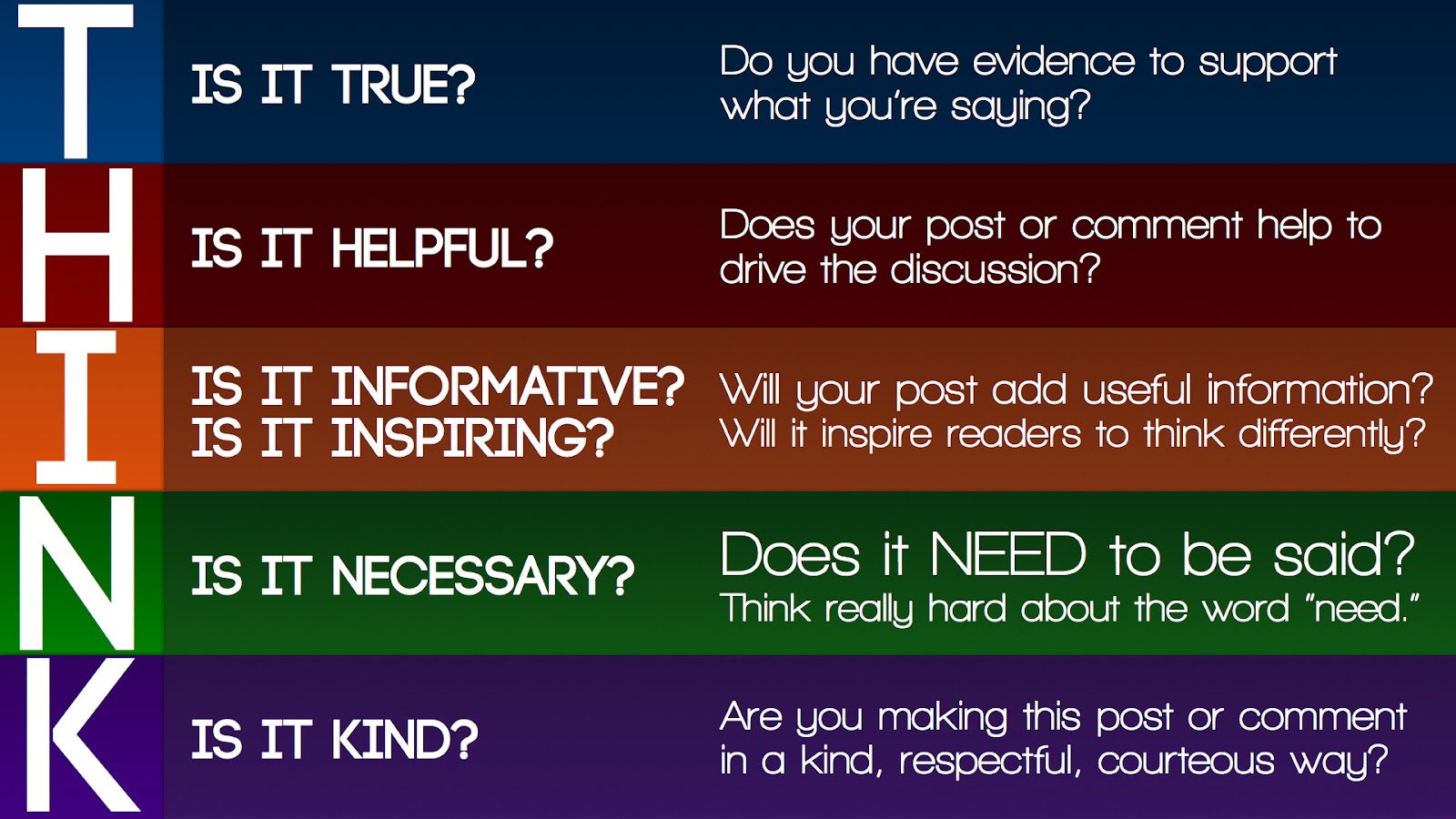
Perhaps our students and children are having such a difficult time being responsible with technology because role models are lacking. Often this isn’t intentional. While it is undeniable and unfortunate that there are adults who take to the Internet to be malicious and inappropriate, there are far more adults who take to the Internet without thinking before posting. I’ll leave you with my favorite resources on citizenship, Flocabulary’s “Oversharing” and this THINK poster:

think.jpg

Samantha Bates is a former middle school teacher and current Director of Member Services for Professional Educators of Tennessee. She enjoys spending time with her family and dancing like a crazy person when no one is watching.