Showing posts with label guest blog. Show all posts

Thursday, August 23, 2018

Changing the Conversation about Technology: A Teenager's Attempt


A few years ago a new family moved into our school community with a young elementary son named Daniel. I noticed immediately he was wise beyond his years. Now, as a high school student he chooses to be different than his peers when it come to social media. He knows balancing is a weakness for him. I asked him to write a guest blog for me because his perspective needs to be heard by those of us teaching students. We, as educators, need to be speaking to students about using technology for human flourishing and the pitfalls of mindless surfing. This is a digital citizenship issue. Hear Daniel's words and heart on the subject:


I have an app that tells me how long I’ve spent on my phone each day, and when I first downloaded it, I was shocked by the results. It was routine for me to spend 3 hours on my phone each day, and not uncommon for that number to grow to 4 or 5 hours. What could I have been doing with that lost time? I don't even want to consider it. Before I got the app (which is called Moment and is free on the App Store), I thought that I used my phone much less than the average high schooler, and that may in fact be true. I think my peers would be as surprised as I was to learn the ugly truth: Americans with smartphones, and especially young Americans with smartphones, spend a gratuitous amount of time on their devices. Lives are being spent in rooms on beds with phones in hand. This is my generation’s life, and it is really no way to live.
What is the solution to this problem? We need to be actively discouraging overuse of personal devices. Of course, parents and educators do call on their children and students to be wary of their tech use. But the caution is tepid. Kids are often told that tech is dangerous because it gives us access to bad content, but rarely do adults tell us that the thing in our pocket is dangerous because of how much time it consumes. I wish I had been warned of that sooner. Pornography and violence is one kind of moral wrong, but I would contend that a life spent scrolling Instagram is another.
I was once hailed as “the G.O.A.T. of Instagram” (the Greatest Of All Time for those who aren’t familiar with the acronym). My posts were clever and funny and occasionally artistic. I would check my phone every minute after posting to see how many likes I had received. I came to find a small piece of my identity in my skill at the social media game and therefore put a lot of effort into my online appearance. One time, while I was curating my Instagram page and looking through others’ profiles on the family lake trip, my cousin asked me a probing question and one that I am grateful for to this day: “How much time do you spend on Instagram?” Instead of being satisfied with my half-hearted answer of “I don’t know,” he told me to check my data usage and see how much I used it. I begrudgingly opened my settings app and was embarrassed to see that Instagram took up most of my data. How could I spend so many of my waking hours on a photo sharing app? I was humiliated when the exact number was revealed to the family and I promptly deleted my page in what seemed like an erratic decision. I have never gotten my Instagram back and I have never regretted my choice.
Since that time, I have had brief flirtationships (one of the advantages of social media is the creation of words like “flirtationship”) with other social medias, most notably Snapchat and Twitter. Snapchat lasted for a matter of weeks before I realized I was slipping into my old habits. Twitter lasted for only 4 days. Thanks to my cousin, I am honest with myself about my lack of self-control where social media is concerned. More people my age should have this awareness but do not because nobody has spoken into their lives about their lack of balance. My cousin harangued me when I was the tender age of 13. I fear that it may be too late for my friends who are nearing high school graduation.
I wish other people had relatives or teachers or friends who could embarrass them enough to inspire change, and I’ve been left to wonder why more people don’t speak out against tech overuse. I believe it is because technology as a concept is a very positive thing. It has taken us to the moon, given us our sight back, increased worldwide food production, and given millions of people jobs. It connects us to the rest of the world and expands our horizons, and it certainly has a place in our homes and classrooms. But just because there are many positive aspects to the mass generalization we call “technology,” that doesn’t mean we should ignore the many places in which personal technology has come to control our lives. Encouraging your student to use Snapchat less is no threat to the scientists at NASA. Technology is not a monolith that can somehow be damaged when I cut down my phone use.
Let’s be honest about the ways in which we take advantage of the wonderful gift of technology. Most of our tech use is simply not productive. I am all in favor of people operating social media pages that promote their small business or advertise their school club. I understand that LinkedIn helps professionals and that Twitter connects leaders to the people, but we immoderately use our phones and excuse ourselves by saying that technology is a good thing that helps people. Of course it does. Now stop sending pictures of the floor to your friends on Snapchat.
Educators and parents have arguably the biggest role to play in not only helping young people spend less time on their phones and laptops, but also helping them use their time on technology well. With the guidance of several teachers, I am hoping to transition our school newspaper online this year and any time I spend on a computer to design and update the website will be, by my estimate, a very good use of time. Not only am I helping to get school journalism out to more people than we could in print, but I am also reducing paper use and increasing the amount of articles that student writers can produce. It is an example of a time when technology is beneficial, productive, and worthy of my time.
I have no illusions, however, that my aspirations for the school paper utilize the same kind of technology as I do when I’m in bed scrolling through iwastesomuchtime.com (not a typo). There are good and bad ways of using technology, and I simply want us as a society to be able to distinguish between the two and cut out the bad technology use like cancer. People my age need help with this. So I am calling on teachers, parents, friends, and relatives to direct the young people in their lives away from their overused personal accounts, where they post self-glorifying images, and towards healthy tech use, like reading articles and trying new recipes and writing papers and learning how to make kombucha. But above all, I am calling on us all to use our phones less. I don’t have any social media, so the thought that I could spend 5 hours on my phone was ludicrous. It is important to note that even if I was using my phone to read interesting things and learn about new places or ideas, I was using it too much. The first step to real change is self-knowledge, so I strongly encourage everyone to download Moment, so they at least know how big a role in their life screen time plays. I was shocked, and my shock has turned into a determination to get better.
If there’s one thing the spread of the smartphone has accomplished, it has been the complete destruction of any semblance of balance in our lives. I want others to live a more balanced life just as I want balance for myself. Smartphones have also tainted the positive aspects of technology by supplanting them with pictures of avocado toast and beach vacations. Technology can be productive and refreshing, but it can also be wasteful and soul-sucking. Let’s get better at knowing the difference.

Sunday, March 15, 2015

How to Be a Well-Connected Human: Digital Citizenship for Adults byguest blogger Samantha Bates

There are a smattering of resources for teaching children how to safely and healthily use the Internet and mobile devices. This is not one of them. This post is for adults.

We’re the ones that children are learning how to interact with using technology. We’re the ones indigenous to the Internet when they create their accounts and get their phone numbers. We’re the ones setting the rules, the culture, and the parameters. Essentially, we’re the reason that digital citizenship lessons are necessary because we’re creating the digital world and digital society.

It’s therefore our responsibility to make it great place to be, and that’s what my post is going to address. But first, a confession.

I hate the term “digital citizenship.”

I’m a millennial. In elementary school, we learned how to interact with others online through this thing called “email”. In middle school, my family got a computer and a modem (and ear plugs), and I got an AOL Instant Messenger screen name (or several, eventually). In high school, I had a LiveJournal diary and a MySpace page, and my family got cell phones. My freshman year of college, Facebook happened.

I cannot fathom a world without online connection and instant communication. I literally can’t even.

This is why the term “digital citizenship” confuses me.  Being a good driver isn’t “roadway citizenship”; being a good employee isn’t “workplace citizenship”; being a good grocery store patron isn’t “supermarket citizenship”. Being online is so normal to me, so natural, that it’s just an extension of who I am. When I’m online, I’m still me. Just online. It’s just another place that I go. When I text, that’s still my voice.

But not everyone thinks this way, and even at times, I have misrepresented who I am and what my principles are. The Internet can be an alternate universe, and if you want to create a completely different identity, that’s within the realm of possibility. “Digital citizenship” and even “netiquette” as terms separate reality (citizenship, etiquette) from the technology when what we really need is more humanity, not less.

When we remember that we are people interacting with other people, our behavior becomes more, well, humane, so here are some helpful things to remember when connecting with others using technology:

Misinterpretation happens.
The majority of communication is nonverbal, meaning that unless you’re video-chatting, most of the way you say what you mean is stripped from your written message. The result? Misinterpretation. It’s just how human brains function; it’s rarely intentional malice (unless you’re reading YouTube comments).

The opposite is also true: when you read something, you might be misinterpreting someone else’s thoughts. The shorter the message, the less context you have. And I’m not even going to describe what autocorrect and autocomplete can do to a rational thought.

Absolute privacy is imaginary.
Last December, Audrey Shores and I did a presentation on Educators and Social Media. In it, we show screenshots of actual tweets and posts that got somebody fired or disciplined. None of those posts still exist, and many of the accounts have been deleted, but the words and ideas will live forever (or however long digital images will exist). Some of them were posts that the person thought were private, or they thought only their friends could see them, or they claimed that the account was satirical.
The truth is that digital communication was created to spread information quickly, even information, files, and images that you don’t want shared. Sometimes we mistakenly publicize something meant for one person; sometimes we reply to all (Thanks, group texts!). Sometimes we text the wrong number. Sometimes we share something with a trusted person or group, then relationships sour, and your thoughts or images are shared without your permission. Sometimes hackers.

Anonymity isn’t for everyone.
There are different reasons for being anonymous online. With our students, we tell them that it’s safer to be anonymous. Also, you can say and do things without repercussion when you’re anonymous, like whistle-blowing. On the flip side, you can say and do things without repercussion when you’re anonymous, like cyberbullying (another term I hate. It’s just bullying.). There must be a balance between freedom and accountability. Before seeking anonymity online, please analyze why it’s so imperative for no one to know who you are. Safety is understandable, but doing and saying terrible things is inexcusable.

Internet safety is for everyone.
In preparing for the webinar, I checked to see how my Facebook page looked from different users, and I was flabbergasted. Anyone I friended had my cell phone number. Perfect acquaintances. Former students. Random mutual friends. I have something like 600 Facebook friends that I’ve amassed over the span of a decade; there’s no way if all those people asked for my phone number I would give it to them, but there it was.

The same applies to using location services. Sometimes an app or site simply shows everyone your city, but sometimes the map gets detailed enough to show your exact location. If you’re using Facebook Messenger from your house, anyone who you message knows where you live. And that’s creepy.

We tell our students and children not to post about being home alone, but when we go on vacation, we tell all of Facebook that our house will be unattended for a specified amount of time.
We tell our students and children not to meet random strangers they meet online, but then we use Craigslist. (A good read: How to Buy and Sell Safely.)
We tell our students and children to report cyberbullying and inappropriate contact, but how often do adults report harassment to site administrators and cell phone providers?

Conclusion
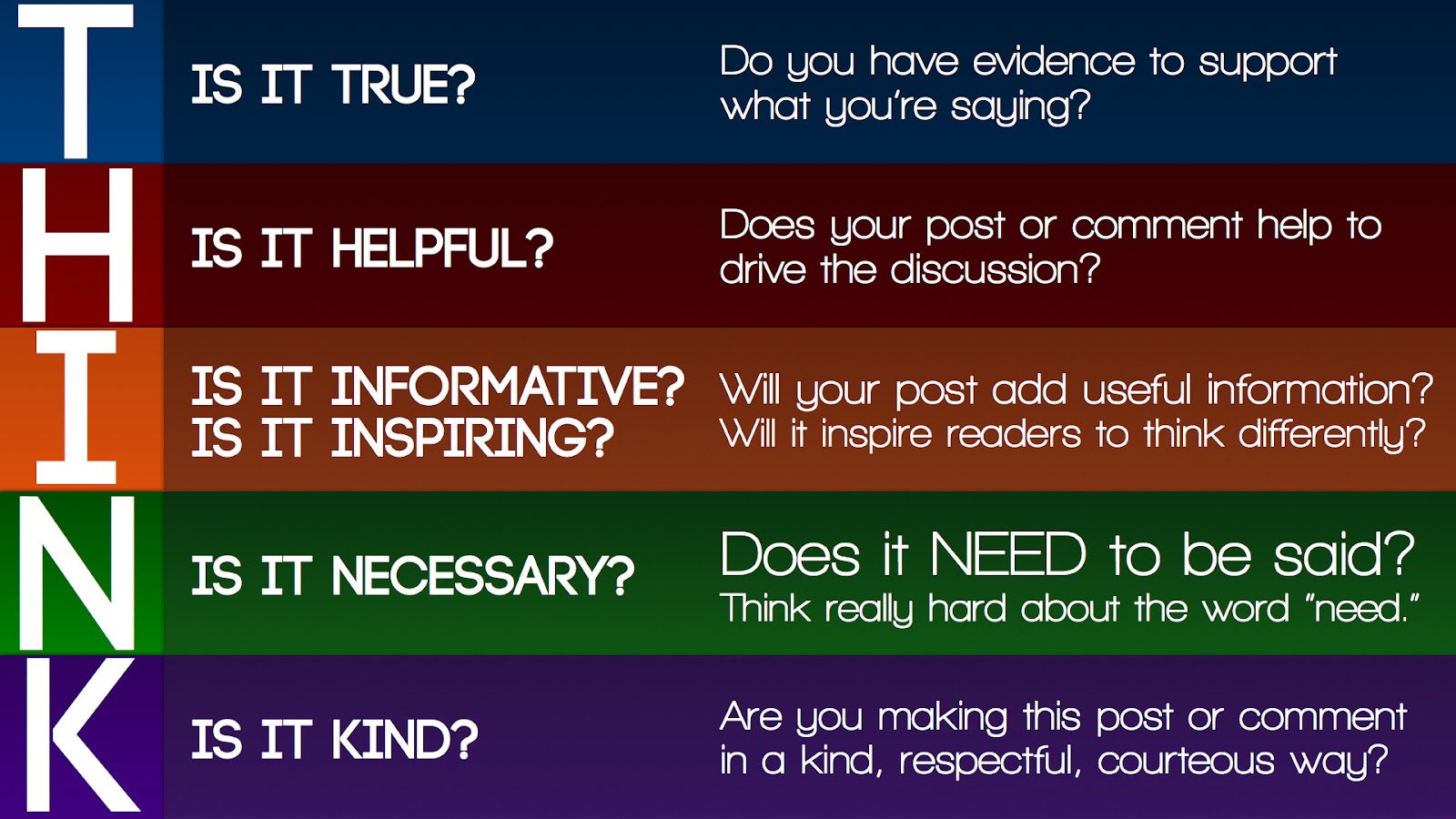
Perhaps our students and children are having such a difficult time being responsible with technology because role models are lacking. Often this isn’t intentional. While it is undeniable and unfortunate that there are adults who take to the Internet to be malicious and inappropriate, there are far more adults who take to the Internet without thinking before posting. I’ll leave you with my favorite resources on citizenship, Flocabulary’s “Oversharing” and this THINK poster:

think.jpg

Samantha Bates is a former middle school teacher and current Director of Member Services for Professional Educators of Tennessee. She enjoys spending time with her family and dancing like a crazy person when no one is watching.

Thursday, January 29, 2015

Guest Blogger: CCS Curriculum Coach-Allison Barham "Can Technology HelpStudents Gain Confidence in Math?"

This year we organized our fifth grade math classes by ability.  We felt that this would make a great difference for the struggling students.  However, this setting created frustration for students and the teacher.  Since the entire class struggled in math, students weren’t able to work independently with success because they didn’t understand what they were working on.  Also, the teacher felt that teaching a whole group lesson was not effective because there were so many students who couldn’t understand the material.  The teacher and I began thinking about how we could structure the classroom to create a successful environment. The teacher decided that all math instruction needed to be done in small groups.  The main concern with teaching in small groups was what were students going to do while the teacher was occupied.  We, along with the technology coach, researched flipped classrooms.  The station rotation flipped classroom model was selected to pilot because it was a better fit for an elementary classroom setting and would allow us to accomplish our goals.

Khan Academy was selected as one of the rotations because of its ability to help students with skills needing remediation and currently being taught, the technology feature that grabs student attention, and the videos available for students to watch repetitively to help them gain understanding.  Even though Khan was proving itself to be effective, there was a resource needed for another rotation.  We researched again to find resources that focused on math facts in a gaming platform because this is a main deficit in students that struggle in math.  We chose Aleks because it allows students to work on addition, subtraction, multiplication, and division.  Once students mastered a certain number of facts, they were able to play a game which caused them to work harder on becoming accurate in their facts.

Both of these rotations have been implemented for about ten weeks.  Parapros were hired to assist students at these rotations to keep them on track and support them when they are having difficulty. Data has been gathered weekly to make recommendations on the skills students need and to check on the progress of student mastery and effectiveness of this model.  Students are continuing to grasp concepts in skills being taught currently.  The teacher has seen enormous success in teaching students in small groups.  

One piece of data that illustrates success in this model, is from Aleks.  Students have been practicing their math facts daily using the Aleks app on the ipad.  Students have gained an average of 10% in their multiplication  and 30% in division facts from the start of this model ten weeks ago!  

With this tremendous gain, student confidence has soared.  Students feel more confident in their ability to solve math problems.  They are asking more questions when they don’t understand.  This increase in confidence is attributed to the technology resource used in this station rotation model.  We are thinking about making these resources available to other grade levels next year to increase math understanding but more importantly build confidence in math.

I believe that if a student has confidence in something, they will more than likely succeed because they believe they can do it.  If schools would focus on building confidence first instead of stressing the importance of mastering all the math standards, students would perform better which leads to mastery in math skills and concepts.  A lot of money and effort isn’t needed to build a student’s confidence.  These simple apps enhanced a classroom setting and boosted student’s attitude towards math that can last a lifetime!

Allison Barham is the curriculum coach at Chattanooga Christian Lower School.  She is a child of God, wife, mom, and lover of education.  She taught in Hamilton County for 12 years.  A graduate of Emory & Henry College, she pursues effective education for students.  

Tuesday, January 13, 2015

Guest Blogger Kent Davis: "For What Are We Preparing?"

When asking for guest bloggers, I decided to reach beyond the academia world and into the business world. Since I happen to live with a business owner I asked him if he would share with the educational society what he sees as an important message from his standpoint. The following is the blog of Kent Davis entitled "For What Are We Preparing?"

I have been a business owner/manager for over 25 years, and I daily help organizations
implement technology successfully. One of the challenges is being able to find and hire
employees who understand, not only the technology, but it’s practical application in everyday
business.

I remember when fax machines came into vogue. I talked to people about being able to send
documents across the country in a matter of minutes. I talked about how that would affect their
ability to get and use information more quickly than their competitors, cost saving of overnight
services, etc. They have now pretty much been replaced by email, but the argument holds true.
Those who figured out useful ways to implement that new technology took a step ahead. Those
who didn’t fell behind.

Technologies will change constantly. I have witnessed that. From a world where an electric
typewriter was cutting edge to a world where you can wear a computer on your wrist, it is how
we make use of the tech that differentiates us. The technologies we find so fascinating or
challenging or controversial today, will go the way of the typewriter and the fax machine.
What I, and many others, are looking for in an employee, are critical thinking skills. The ability
to evaluate a situation and use the tools available to influence it. Someone who mastered the
fax machine, does not have a marketable skill today. Someone who understands how to use all
available resources to convey information accurately, quickly, and effectively does.
I don’t have a punch list of how to prepare students. I am not sure that it should have changed
a lot. Just like my business. We do exactly the same thing we did over 50 years ago. We
help businesses implement current technology in ways that increase their effectiveness and
profitability. We have to not get sidetracked by the technology, but stay focused on how to utilize it to our advantage.

--Kent Davis is the wife of Julie Davis, the mother of Jessica and Kendall- his greatest assets. He is also the owner of ACT Business Machines, Inc., ACT Print Division, and Chattanooga's Julie Darling Donuts. He was born and raised in Chattanooga, Tennessee with a brief stint living in Athens, Georgia while attending The University of Georgia to receive his degree in Business Management. He believes in the idea of local businesses and has been a part of one his whole life, as his father was the former president and owner of ACT Business Machines, Inc. as well. He enjoys mentoring small business owners to give back to his community and he also serves on the board of directors for Chattanooga Community Kitchen.

Sunday, January 11, 2015

Digital Citizenship Guest Post from STEM Principal Tony Donen

Earlier this month I asked some of my twitter PLN to guest blog for me regarding education. When deciding who to ask, Dr. Tony Donen was one of the tops on my list after visiting his STEM school at Chattanooga State College this school year. What immediately caught my attention when visiting their school was how trusting they were that their students were using technology appropriately and that their students were rising to the occasion and using technology correctly.  I then asked Dr. Donen to share how his school addresses digital citizenship for my blog.

This is the link to his blog on digital citizenship at the STEM School of Chattanooga: http://tdtalkseducation.wordpress.com/2015/01/09/digital-citizenship-how-does-that-happen/ Dr. Tony Donen has worked for the past twelve years as a high school principal.  Originally born in South Africa, Tony grew up in Canada and then the United States, where he graduated from high school in New Jersey.  Tony received a bachelor's degree in engineering from Virginia Tech University, a master's degree in teaching from East Tennessee State University, and his doctorate degree in educational leadership from Trevecca Nazarene University.
Tony has worked as a teacher, coach, and administrator for the past 19 years in education.  His leadership has resulted in school recognition on Newsweek's list of top public high schools, mutiple years of 96% plus school graduation rates, and a standards-based implementation for ACT that resulted in two to three point schoolwide gains on the ACT assessment.  He is the lead author for the book Grades Don't Matter: Using Assessment to Measure True Learning and co-author for The Grades Game, an article published in the educational leadership magazine Principal Leadership. Tony is the founding principal for STEM School Chattanooga and is committed to helping improve STEM education in the southeast region of the country. 

I greatly appreciate his willingness to share with me and my followers how they address digital citizenship at the STEM School of Chattanooga. Stay tuned for more Guest Bloggers here!