Showing posts with label educators. Show all posts

Friday, May 3, 2019

The Chasm Grows: Public versus Private

My heart is burdened. One of the things that always bothered me as an educator is how polarized I often felt as a private school educator when I attended conferences. Oftentimes the conferences are sponsored by state education departments and even in the opening sessions I can feel completely confused at the acronyms and current mandates being discussed. I have even felt judged at times because I have chosen to teach at a Christian private school at this point in my life as opposed to public schools. I didn't like how the chasm made me feel. I remember discussing it with a public school educator friend and he said, "I think there is a lot we can learn from each other. We each have things we do well. For instance, I stand amazed at what private schools can do with so little money." That very simple statement made me feel the support I needed at that moment.

The desire to mend this chasm started working on me thanks to Edcamp Gigcity. As part of the planning team that represented private, public, higher ed, and k12 educators I made friendships that helped me to see it was time for me to be intentional in trying to break down the walls I felt in order to prosper as an educator in ways that each group could offer. Greg Bagby, the coordinator for educational technology for Hamilton County, Tennessee schools has always been a friend and resource for me. Together, we currently co-moderate #TnEdChat weekly twitter chat. This is a really simple way to get out of the silo of your workspace to hear the thoughts of other educators across the world, not just your state. The connections I have made through this chat have helped me to feel less disconnected with fellow educators.

From that, I started a monthly coffeeEDU opportunity. This concept was first developed by Alice Keeler. Our #CHAedu monthly meet up allows educators from anywhere in the Chattanooga area to get together for one hour, one day a month to discuss educational topics of their choice. What I gain from these Saturdays is amazingly valuable. Representation from different states, districts, and roles helps me to see outside of what is often my narrow viewpoint. And as Jim David once said to me regarding a conference he was attending, "I didn't know what I didn't know." This monthly event is often eye-opening for me.

By choosing to bridge the chasm between public and private schools I've learned that if I want to know something about Open Education Resources, Dan Lawson is my guy. If I have a burning question on how to utilize a chromebook for math instruction, I can reach out to Dan Lyons. If I want to query area schools about their SIS, I can ask the pros and cons of what my friends use and I get real answers.

But I see outside forces making each camp feel uneasy. Even more disturbing, I am seeing educators feel they have to "protect" their schools. Public school educators feel they have to wear shirts that say "I love Public School." Private School educators feel the generalities being said about the boujeèness of their jobs are unjust. Instead of bonding together, the chasm grows. I believe wholeheartedly that I am exactly where I am supposed to be a Christian school educator. I also know my friend Jennifer Rimback feels completely in God's will being a guidance counselor in public education. I stand amazed at the level of care she gives ALL the students at the high school she is at even though the number of students has to feel like a daunting task. I sometimes get jealous of the level of support Greg Bagby gets from software companies due to the funding of those initiatives by his county.

What I know is in my amazement, confusion, and sometimes even jealousy of what is going on in the schools of all my educator friends, we are better together. My prayer is that we can rise above the things that polarize us and continue to grow together to benefit all students everywhere. Less finger pointing, more applauding the positives and helping each other work through the negatives. We are all facing the daunting task of being called to educate the workforce of the future. Let's continue to model the importance of linking arms in this bigger journey called life so that we can learn from each other.


Sunday, January 21, 2018

What kind of PD makes teachers smile? And on Saturday? EDCAMP


Year five of Edcamp GigCity is in the books. It was in a fabulous location- Red Bank Middle School in Chattanooga, TN- and it had fabulous attendees. According to the feedback form most left as very happy campers! (pun intended).

Things I learned:
  • Oops on the schedule. We accidentally used the schedule from 2 years ago instead of last year so the sign up said 9-2 but the day was laid out as 9-3. We also had adjusted times down to 45 minutes last year but the old schedule had the sessions at an hour. Our bad! We apologize for that oversight and promise it won't happen again.
  • Many hands make the burden light. WOW! What an amazing organizing committee we had this year. Being the lead for the last 3 years, I am finally learning how to delegate and trust the team. I was not disappointed. Sure am thankful for a wonderful group of fellow educators. What many people probably don't know is that this is all volunteer led and run, and Edcamp Gigcity is unique in that the organizers represent higher ed, lower ed, public, and private school sectors. I love that about our edcamp! This uniqueness opens the door for collaborative thinking way beyond the walls of the school house, the district, and even the city! I can't even begin to say how much I appreciate the following organizers that planned along with me this year:
    • Dr. Karen Adsit, Education Professor at The University of Tennessee of Chattanooga
    • Greg Bagby, Principal at Barger Academy
    • Jim David, STEM School administrator 
    • Kimberly Elbakidze, Computer Science Instructor at Red Bank Middle School
    • Evonne Hackett, Technology Teacher at Lakeview Middle School
    • Julie King, Middle School Librarian at The Baylor School
    • Arthur Williams, K-5 Instructional Technologist at Lakeside Academy
  • We need to make sure we explain how edcamps work a little better for new attendees. Often people are a bit overwhelmed by the "no presenters" and "rule of 2 feet" if it is their first edcamp. We need to make sure we provide more insight on how edcamps got started and why it is so organic in nature.  
  • The EdCamp philosophy makes people smile. All day long I watched as people moved around from room to room at EdCamp Gigcity with smiles on their faces. I couldn't help but ask myself, "Is this what you see when you lead PD at school?" And I answered myself (because I'm weird like that) "Not usually." So why do educators like edcamps? I have 3 theories:
    • Choice- Educators are at least college graduates and sometimes/often even have advanced degrees...they love Edcamps because they get to choose what they learn about instead of being forced into a PD that may or may not interest, help, or pertain to them. 
    • Voice- Educators get to ask questions and share their concerns and fears in a safe non-threatening environment. The beauty of our edcamp is that it isn't "district led" so the voices they are in a room with aren't necessarily the ones they usually hear from so it adds a freedom to learn from others. The value of being heard is important to everyone, the nature of edcamps is active participation no matter what your level of understanding. 
    • Free- The event is free, the food is free, and the door prizes are both awesome and free. How does that make an educator feel? VALUED. For some educators, they rarely have the opportunity to learn outside of their school building because of cost or time. Edcamps show teachers that they are appreciated and important by creating platforms for them to learn without other things hanging over them- like lesson plans for subs and money.
  • Being an #EdcampGigCity organizer make me a more connected educator. This is year five of our edcamp and every year I walk away with new edufriendships, knowledge, and ideas that I know I have a safety net for if I have more questions. Like all conferences, you get what you put into it. Allowing yourself to connect with others and hear what other schools and districts are doing brings value back to yourself and your school/district. I'm thankful for the opportunity to connect in such a big way to the Chattanooga are. #CHAedu

Tuesday, October 31, 2017

Educators as Learning Catalyst Collaborators


Collaborator - Educators dedicate time to collaborate with both colleagues and students to improve practice, discover and share resources and ideas, and solve problems. Educators:

  • Dedicate planning time to collaborate with colleagues to create authentic learning experiences that leverage technology.
  • Collaborate and co-learn with students to discover and use new digital resources and diagnose and troubleshoot technology issues.
  • Use collaborative tools to expand students' authentic, real-world learning experiences by engaging virtually with experts, teams and students, locally and globally.
  • Demonstrate cultural competency when communicating with students, parents and colleagues and interact with them as co-collaborators in student learning.
"Research has shown the power of collaboration in improving educator practice" (Ronfeldt, Farmer, McQueen, & Grissom, 2015). Creating opportunities in the day for students to have authentic learning opportunities while collaborating with myself or others makes learning relevant to our students.  To acknowledge the fact that teachers no longer have to be the "sage on the stage" imparting all knowledge on our students creates a sense of collaborative learning that grows both the teacher and student. Leveraging technology to knock down the walls of our classrooms to multiple viewpoints and experts creates opportunities for all of us to grow in our learning journeys on any topic.  

Last year we had a group of middle school students that would secretly look up information that their teachers shared with them to see if they were "true" or not. What a great opportunity for teachers to allow those challenges in the classroom and grow forward from them with their students. Personally, I can see a future of using iOT devices in classroom for just these types of challenge moments. Siri, Google, or Alexa could share information with all the students at the same time on the challenged topic. This would allow for students to learn how to do better key internet searches together.

Many teachers fear that their students know more about technology than they do and therefore they don't want it in the classroom. What if we harnessed their knowledge by empowering them to diagnose and discover educational technology issues and tools? Last year I had the joy of working with a group of elementary students that chose to be a part of an elementary tech team. This team empowered them to help others in our school with tech issues. See their website here: https://sites.google.com/a/ccsk12.com/ccstechteam/

I am so thankful for the Google Suites for Education that allow me to collaborate with teachers and students in real time through the use of Google Hangouts, Calendars, Docs, Slides, etc. Leveraging digital real-time tools allows for more group projects to enhance the 21st century skills they need for the future. One of my favorite lessons was when a teacher friend of mine that lives in the Philippines stayed up despite the 12 hour difference for a Skype call with seventh graders learning about Eastern Civilization. This teacher's father actually is in the history books in the Philippines because he was a key soldier during the 1989 coup.  What a real world opportunity for our students! Creating learning environments that teach us and our students about cultural identities can be enhanced through the use of technology to understand those cultural differences. 


What I love about this standard is that there is no expectation on a teacher to know know all the answers. The onus is on the teacher to learn along side the student. This creates a culture of teachers as facilitators of learning and gives ownership to the students for their path of learning. In the immortal words of Albert Einstein,  "education is not the learning of facts but the training of the mind to think."


Monday, October 23, 2017

Educators as Empowered Citizens (Unpacking the ISTE Standards for Educators)


Empowered Professional
3. Citizen- Educators inspire students to positively contribute to and responsibly participate in the digital world.
   
Educators:

  • Create experiences for learners to make positive, socially responsible contributions and exhibit empathetic behavior online that build relationships and community.
  • Establish a learning culture that promotes curiosity and critical examination of online resources and fosters digital literacy and media fluency.
  • Mentor students in safe, legal, and ethical practices with digital tools ad the protection of intellectual rights and property.
  • Model and promote management of personal data and digital identity and protect student data privacy. (ISTE Standards for Educators 2017)
Part of using technology in the classroom is both modeling and creating opportunities for ourselves and our students to be a productive part of the digital landscape. For me, this means talking about digital citizenship on a regular basis with students and holding them accountable for appropriate actions as well. It means using myself as an example. The following bold titles are the subcomponents found under this section of Empowered Citizens in the ISTE Standards for educators. The explanations below are ways I model being an empowered professional digital citizen as an educator:
  1. Make positive, socially responsible contributions. I am an avid edtech blogger. As much as it helps me gather my thoughts and think through things, I also see it as a way to model and show positive professional digital behavior. While the free online community of the internet gives us rights to so much information, also contributing to the digital landscape should be a responsibility of an educator. 
  2. Exhibit empathetic behavior. As an active member of various Twitter chats, sharing my views on different topics is part of that community. While my views may vary from others, being respectful and open to the views of others online is an important part of being a productive digital citizen. For me, I often friend or follow people that have different views than myself to grow my mindset.
  3. Building relationships and community.  Through the use of the Google Suites apps I am able to collaborate online with fellow educators both in my system and outside. Google Hangouts, Google Docs, and my Google Calendars are used on a regular basis to stay connected to my community. Becoming a moderator of #TNEdChat twitter chat on Tuesday nights at 8pm ET has also help me grow my community and build relationships with other educators both near and far. Modeling this active use of technology to grow myself is important to me. Twitter has become my "go to" whenever I find myself stuck with an educational issue. I can tweet a question out and because I have an educational learning relationship with many of my followers, I often get immediate suggestions and ideas to move forward. 
  4. Establish a learning culture. Our school has recently created a "philosophy of technology" to guide our learning. After creating that, we then created a graduate profile in terms of technology skills we want our students to have when they graduate from our school. We are currently in the process of breaking that graduate profile into true technology standards by grade level that we want to make sure our students are reaching. As an educator, I think it is important for parents and students to see that we are diligently working towards a framework that shows both value in using technology for education and the limitations we think that are needed in regards to good stewardship of technology. 
  5. Curiosity. Access to technology allows myself and my students to see a myriad of viewpoints on any topic of interest. For myself, when questions come up in class that have pricked someone's curiosity, we use digital tools to learn more about subjects. I do the same every day. Creating a culture of lifelong learning with digital tools helps students to see the importance of how quickly they can learn with the right keyword search. I also model this for other teachers when they ask me how to do  something digitally and I find a resource online through Youtube or a blogpost and share it with them. We are in a world where the smartest person in the room might actually be the computer. To access the information and turn it into knowledge is contingent on our own curiosity.
  6. Critical examination of online resources. Learning how to critically look for resources on the internet is a valuable tool. It is important for teachers to learn how to discern good resources for our students. Learning where to look for the owner of a website and doing comparisons with multiple websites helps us to share and learn non-biased information with our community. Teaching our students how to do the same is also important. Many years ago I would create fake websites that made no sense to what my students were studying about and send them to the web address. Teaching students how to critically look at online information is a definite skill for all of us.
  7. Digital literacy. As a digital citizen I have a responsibility to learn how to use technological tools effectively. One of my pet peeves is when classrooms just digitize what could be done with paper and pencil. While there is a time and place for all levels of tech usage, using technology in 21st century ways helps our students for their futures.
  8. Media fluency. Whether I am curating or creating information it is important to have a technology toolbox that gives me varied resources. Whether I find my information using Google Scholar, Twitter, or Edutopia I should look for multiple places for information. Just like I want my students to have multiple sources for papers, I should be creating a digital toolbox for myself. Because we have already talked about the importance of contributing to the digital world, we also should be looking for various digital formats to communicate and share our knowledge.
  9. Mentor. I am thankful for mentoring people in my own life that have grown me as an educator. I too try to help others (if they want help) through various digital outlets. I share my own failures and successes on my blog for anyone to see. I use the hashtag #CHAedu to share thoughts with local Chattanoogan educators. I offer help in my community through edcamps and technology conferences. Please hear me say I don't think I am a master teacher but I do try to help others as they navigate edtech because I have been doing it for a while.
  10. Safe practices. I model safety by only accepting people I know to view my personal life online. I also make sure I don't share too much personal information when talking with others. I often will block Twitter users that don't seem to have a legitimate reason to be following me. I try to keep my social media accounts clean from spammers and questionable followers.
  11. Legal practices. I try to give credit when I quote other people or articles online. If I share graphics, I either make them myself or get them from somewhere like www.photosforclass.com  so that they are creative commons cited.
  12. Ethical practices. When I see rude or inappropriate comments on the internet I do not participate in the conversations. I have been known to contact people directly when I see cyberbullying taking place. 
  13. Protection of intellectual rights and property. As mentioned in 11 above, using creative commons and making sure to cite the works of others when I blog, tweet, or share shows the importance I place on the works of others. This helps students to see what non-plagiarism looks like.
  14. Model and promote. I'm probably annoying about this. I remind and show teachers the value of a positive online digital footprint often. I promote the importance of doing that for our students. So many teachers don't want to participate in social media but I think it is important for us to show it positively to our students. I also feel it is important for me to model using social media for educational purposes for my fellow teachers to see. 
  15. Management of personal data. By modeling personal contact through direct messaging and showing the importance of private versus public accounts, I show others how to manage their own personal data. 
  16. Management of digital identity. By being mindful of my digital footprint and the persona I want others to see regarding me, I am careful about what photos I upload, who can tag me in photos, and how others might see me. 
  17. Protect student data privacy. It is important to not use names of my students online and if my students' parents don't want their identity represented online I adhere to their wishes. I am also careful about asking or creating accounts for students for learning purposes. I often will choose software that works with Google because I know my students can sign in through their accounts. This allows me to protect the privacy of my students. 
We often talk of the importance of digital citizenship for our students but we are lackadaisical about teacher expectations on the same topic. Many teachers feel that their digital identity is their own business and shouldn't be judged or have expectations on it but we live in a society that values social media and its connections. Our digital identifies are the only way some people know anything about us (and our students). We need to start teaching into this aspect of our students lives by modeling empowered digital citizenship behavior. 

Thursday, September 21, 2017

Five Educator Groups for Technology Integration


Recently I've been thinking about technology integration and I read this article https://ondigitalmarketing.com/learn/odm/foundations/5-customer-segments-technology-adoption/. While this article is not talking about eduction, the labels of the 5 segments of technology adopters resonated with me as I daily work with teachers helping them integrate technology into the classroom.

The article suggests "not everyone will adopt a disruptive idea despite obvious benefits." The article then quotes the research of Rogers to place adopters of technology in the following segments (my thoughts follow each label as it relates to what I see in education:

  • Innovators - These are the people that actually thrive in change and long to be change-agents because they are not convinced the status quo is what is right, or best, or easiest, or (fill in the blank). Innovators are often alone in their convictions and because educational systems change very slowly, they are often very frustrated with the day to day of educating. My definition of innovation has always been "the point where need intersects with passion under an umbrella of creativity." Innovators don't always use technology to get a job done but those that do are often seen as risk takers or rebels. For some administrators this is seen as a good thing and for others it is terrifying. The innovative educator is willing to fail, they have an open mindset, and sometimes have to be corralled back into the fold for the good of the whole but innovators need opportunities to try things. As a rule, there are very few innovators in a school building. In fact, I bet the 2.5% mentioned in the article is just about right for educators that are innovators in a school system. 
  • Early Adopters - These are the ones that are willing to take a risk and even feel comfortable with learning things on their own to understand things better but they aren't necessarily the ones out their looking for the cutting edge thing to change their classroom. They are the ones that once they hear about it they think "YES! That's what I need." Early adopters have a strong influence on the other educators in their building. Because they are often seen as individuals that understand technology easily, others are watching to see how they react to new technologies. Early adopters tend to look at technology as a way to teach differently instead of trying to fit a technology into the way they already teach. 
  • Early Majority - These are the educators that are obviously a bit slower in adopting the idea of change in the classroom but being followers, they look to the success the innovators and early adopters have had and decide to join the party. The early majority often feel they are not equipped to use technology but rarely take the initiative to learn more on their own without clearly laid out resources at hand. The early majority's success or failure with new technology is often in direct correlation to how well they feel that technology fits how they teach and how often they are willing to try to use it. The early majority often feel they need hand holding and support but tend to thrive once they truly understand the capabilities of the technology.
  • Late Majority - These educators are the ones that do not really want to change but feel they must either because they are being told they have to or because they realize their lack of change is making things harder for themselves. These are the skeptics among us. The ones that fear that "next year there will be something else you will want us to do instead." These are the ones that may not truly believe that technology integration is what is best for the students so unless they are "forced" they do not adopt or adapt. These educators often don't feel equipped to "take on" technology but they don't take advantage of growing themselves in that area either. These are the ones that panic when something doesn't go right and truly appreciate and expect great support. The innovators, early adopters, and early majority really have little impact on the thinking of the late majority adopters but the late majority adopters often give a balance to the early majority and innovators in discussions. When I "win over" a late adopter it is like Christmas morning for me. These are the educators that sharpen me to know my stuff and be able to justify my reasoning for tools. 
  • Laggards - These educators are the ones that either vehemently oppose all things technology or strongly believe (and maybe rightly so) that they can teach their classroom just as well without the use of technology. The laggards are the ones that will refuse to follow set norms in a school about technology usage in either an intentional and/or unintentional way. There is often something in their life that makes them fear the technology. These educators often do not have much influence upwards due to being viewed as closed-minded. 
Obviously each segment of technology adopters bring value to the conversation of what is best in the educational setting. Each group presents a balance to the others that often leads to a more acceptable medium adoption rate of mass technology rollouts at schools. I believe schools need representatives of all segments to best meet the needs and have a pulse on the community the school serves. 

I often find it interesting how educators can move from one segment to another based on the technology being rolled out, the grade level of their students, and the subject matter curriculum they are teaching. Unlike the article, I have found that age doesn't necessarily place a teacher in certain segments. Some of the most amazing technology integrators I have seen have been over the age of 55. I do think the receptiveness to change is the biggest indicator. And the truth is, as a rule, education systems do not change quickly. You could walk into almost any school in the U.S. today and see rows and columns of desks with a teacher in the front just like you did in the 1800's. Education is built on tradition. Educators are often the type of people that thrive in routine. It's the nature of their world. 

I believe education as a whole has changed more since 2010 and the advent of the mobile device than in any decade in my lifetime and dare I say in my father's lifetime as well. I also believe with the constant growth of educational technology towards smart software, quick assimilation of data, streamlining of basic tasks, and the ability to personalize learning more easily we will see the average classroom continue to wrestle with the exponential change opportunities out there. I truly wonder what the education system will look like for my grandchildren one day. Will it be better or worse? More sterile? More active? Less relational or more relational? Will certain schools stand firm in the idea of traditionalism and what will that look like for those students? 

Friday, May 26, 2017

The Power of Caring Educators

I'll be honest, it's easy to become jaded in education. New initiatives, students that don't seem to care, parents that question everything you do, not being respected in your field...it's easy to allow the stresses of day to day make you forget what made you want to go into education to begin with.

But then there are educators that are different. Ones that both value the relationships with their students and see the challenges of everyday as purposeful. I've seen many of those teachers over the years but in the last couple of weeks I have experienced two educators that truly challenge me to be more like them, to look at being an educator as missional.

As my role has changed over the last few years and I spend less time in contact with students I have less chance to be relational with them. But because of the two people I am about to share with you I want to make sure I am not overlooking those opportunities to be a caring educator.

The first person I want to share about I have never even met in person. Principal Todd Jackson of Sequoyah High School in Soddy Daisy, Tennessee has a heart for students. He leads a school that gives a student a "hands on" education. Many of these students haven't succeeded in the traditional academic setting for a variety of reasons but they can leave Sequoyah equipped to either go straight into a career or further their education. While I have never met Mr. Jackson, I have seen his heart for students. Last Saturday, my nephew Tanner graduated from Sequoyah High School. As Mr. Jackson stood up to speak to those graduates he was obviously overwhelmed with emotion in that moment. He couldn't hide it. As one person yelled from the audience while he was trying to hold back his emotions before continuing on in his speech, "that's a man who cares!" It was evident in that moment but it was also evident to me because this man had been investing in Tanner regularly. He had invited him to his farm and had Tanner work with him, hand in hand. He made a difference in Tanner's life. Tanner left for basic training on Monday and Mr. Jackson played a huge role in getting Tanner to that place. He is an educator that values the importance of relationships.

Secondly, is a teacher that retired from Chattanooga Christian School and someone I had the honor of working with for many years. Not only was she a co-worker, she was a teacher and tutor to my oldest child. Mrs. Pat Wilson was always a relational third grade teacher. Teaching was more than an 8-3 job to her. She would attend baseball games, recitals, and special events of her students often throughout the year. She always invited the students to her house for a party each year. She saw teaching as being in a covenant with the children she taught. She valued them in and out of the classroom. Last night, my youngest daughter got home from her senior trip to find a stack of graduation congratulation cards on the counter. In that stack was a sweet note from Pat Wilson encouraging Kendall for her future and congratulating her for her progress. What makes this unique? Pat wasn't even Kendall's third grade teacher. But she was Tanner's. And she has already asked for his address to send him a message while he is in the Army. This is what relational education looks like- even from a retired teacher.

I want to be more like these two people. I am a very passionate instructional technologist and I want all students to feel like a success in their educational endeavors. I do believe educational technology has the ability to help teachers better meet individual student needs. But the truth of the matter is, no matter how automated and effective edtech becomes there is NOTHING that will replace the power of caring educators. So to all of you that model this daily, thank you. For those of you that know there is room for improvement, like myself, take up the challenge with me. I am thankful for educators like these two that show me how I can better myself in an area where I hadn't even realized I was lacking.

Friday, January 13, 2017

Educators Need Safety to Share Their Story


Teachers need to feel safe in sharing their story. Teachers are doing amazing things in their classrooms. I don't know who first said "if you don't tell your story someone else will" and I even looked it up to give credit where credit is due but what I found as it's been said many, many times. Which means there are many, many people that have experienced what this means.  

I remember the first time it happened to me in an educational setting. I was sitting in a room at the beginning of the school year with all the K-12 teachers in our school system and it was rhetorically asked by the speaker "why do we teach computers to elementary students in a standalone setting? Why doesn't it support what is happening in the classroom?

I wanted to stand up and scream "that's not true! It does! I'm doing my best to make it   with the classroom learning!" but it wasn't one of those situations where I felt could do that and as I felt tears stinging my eyes, my friend and co-teacher sitting right next to me patted me on the knee and said "it's OK, we know how you actually teach." 

This was before the age of social media. It was basically in a setting of silo'd teachers doing their best day after day with very little adult contact. That was the culture of the day.

But that's not today's culture. Sometimes when I walk into a classroom students don't even look up because they are so used to other adults coming in and out supporting, aiding, watching what's going on that it's the norm.

I think maybe because of my past I have wholeheartedly chosen to share the amazing things going on in education with the world whenever I can. I believe 100% that someone's telling your story and it might as well be you so it will be correct. Sharing your story via blogs and/or using social media, or face to face with other educators helps create a system of transparency that parents and students seem to appreciate.

But very often other educators look at me and say "wow you really do a lot of sharing of the things that you guys have going on in the elementary school but I'm scared to do it. It's risky, what if I say something that is taken the wrong way? or that someone doesn't like?"

I honestly sat there complexed. What would you be saying people might take the wrong way? And then I realized I've had those moments-moments where I needed to explain a little bit about what was going on to help people understand better what our goals and standards were. But I never feel like I've had my hand slapped for something I've shared. I have been questioned but I don't have a problem with that. And as an innovator, I should be questioned. No educator should have free reign. There should be some boundaries. I'll be honest I think my sharing has brought me more positive results as an educator than negative. I love telling our story at our school because I love our school. If I post something that someone doesn't agree with (which has happened), or that is misinterpreted (which definitely has happened), they have to know my heart. I am an educator who passionately believes in her students and the faculty at my school. Our story is a great one and I'm proud to show it. 

It makes me sad to hear about other educators not feeling safe to share their stories. How I long for everyone to have the freedom and feel a school culture that gives them the safety to share, to not be criticized for thinking or feeling differently on a subject. I think as long as we don't bash other's thoughts and we share kindly and in a way that does not harm our school's reputation then administrators should welcome educators that have good things to share and are willing to share.

 Over the past year I've really tried to strive to share the positives as I'm walking down hallways, as I'm looking in classrooms, as I'm seeing people interact, as I'm teaching, as I'm watching students learn and watching children play. Educators and schools get bad wraps every single day. It's time to create a culture where teachers feel safe to share the good things going on. Let's do it! Grab a hashtag for your school and GO! I've adopted #ccslearns and invite other CCS teachers to get on this hashtag's share train!  What's yours?

Monday, February 1, 2016

What if Chattanooga's Connected Educators Were Even More Connected?


In the last 3 days I have posted 3 tweets that look a lot like the one below. In the 3 different ones I have tagged #CHA #hcde and #ccslearns in hopes of getting a few more noticed. So what were the results?
I had 17 unique educators notice the tweets and respond- three of them were superintendent level educators, a few were edtech edus, at least three were principals or assistant principals and the majority seem to be classroom teachers but I do not know for sure. I know for a fact that we have more connected educators in the Chattanooga area but for whatever reason the tweets weren't noticed. Which leads me to the WHY of my postings. 

Lately I've been wondering just how many connected educators were in the Chattanooga area and how I could make sure I was connected with them on Twitter? I've been wondering what these educators are doing that our school might benefit from seeing? I've been wondering who in my area is leveraging the learning ability of social media for their school practices? I've found myself wondering if the teachers in my city know about the upcoming Edcamp Gigcity and how could I make sure they know about this awesome opportunity?

Last week I had the opportunities to co-lead a session at the Administrator's Technology Academy (ATA) sponsored by the East Tennessee Education Technology Association (ETETA). While speaking to a packed out, standing room only crowd I realized there were only two attendees that I recognized - Allison Fuller-Mulloy and Amy Myhan. It dawned on me that there might be quite a few more educators from Chattanooga in the room but I just didn't know them.

What if there was a way that connected educators in Chattanooga could connect more readily? At Edcamp Gigcity last spring there was a session about citywide collaboration. Many in the room wanted it to happen. To be honest I took lots of notes, had grand plans and they all fell through in my lack of vision. But what if we all started following and creating locally based tweets that might be of interest to other educators with the hashtag #eduCHA? With #eduCHA we could let each other know when opportunities for learning are taking place, we could check to see if there is truly enough interest to create "lunch and learn" opportunities in the summer, or #CoffeeChatCHA opportunities at that cute little donut shop on Frazier Avenue one Saturday morning a month. We could connect and share triumphs, dissect failures and learn from each other more.

What if I knew that a local educator was doing something that I want to see be done at my school? We could hop in my car and head over and see it in action.

What if more educators in our area were using social media for professional development opportunities? One thing that keeps coming back to me over and over in my very small "test" was that almost 30% of the educators that responded to my tweets were administration level. What does this say? I think it tells us that many school system leaders at least see the value of Twitter for professional development. They may not expect connected educators but I think we can make the assumption they notice them.

What if more of those teachers that clicked that like button became more than "lurkers" on Twitter and actually shared things? I was a lurker for a long time before I started adding things to Twitter. There is nothing wrong with lurking and learning but each educator has a voice to share. Take a chance, model good digital citizenship skills (don't bash others or your school) and bump up your twitter involvement to see what you can add to your PLN (professional learning network).

What if more administrators took part in Twitter conversations? Some of my favorite twitter chats to participate in include Dan Lawson, superintendent of Tullahoma City Schools. Dr. Dan adds a viewpoint to chats that many teachers overlook. I am thankful for his use of Twitter because it has grown my own personal views as I have listened and learned from his viewpoint. That being said, administrators should make sure that Twitter is a safe place for teachers to be transparent and real in their sharing. Voicing opinions should be allowed. Obviously if someone is bashing the school or an individual that has to be addressed but teachers shouldn't be scared to share their fears and discouragements safely. There is too much goodness to glean from Twitter, Google +, Voxer, etc not to give teachers the power to feel free to discuss!

I am not trying to start a movement or create a subculture. I just want to be able to look beyond the four walls of my school for support and my global community starts the moment I step out of the front door of the school. Let's connect and collaborate!

Thursday, January 14, 2016

The Unsettling Stomach Lurch of Teacher Branding


Recently eduawesome Refranz Davis shared this recent post she wrote on her thoughts of the need to be "visually appealing" as an female edtech speaker. Refranz has been a champion for the underdog and I admire her for it. She posted the above post on Facebook and a few of us edtech women jumped on it and ran with the idea of "branding." Refranz quickly said that wasn't the direction she was going with the post, which we understood, but I find it interesting how quickly the three of us found the connection to branding.

I just googled "teacher branding" and in .36 seconds 13.8 million results came back...no lie. What is teacher branding? To put it succinctly it is marketing yourself, your skills, your knowledge as an educator in a way that establishes a positive presence in the minds of others.

The idea of needing to brand oneself as an educator makes me feel uneasy. During Christmas break I shared that fact in a Twitter chat with a tweet something like this: "I struggle with the fact that edus feel they must brand themselves to be heard. We all have value." I was amazed at the number of people that this resonated with. I am realizing this statement rings true to a many in the educational community.

I then found myself digging deeper into the thought of branding. What bothers me about it? What good things come from it? And I will be honest, my t-account of debits and credits felt fairly equal. The pros: It allows an educator that's doing great things to have a larger and louder voice. It potentially opens up another form of income for these educators in leading professional development opportunities or having the ability to be an edtech speaker. Branding makes the school system these people come from look like an innovative thinking school. Branding actually leads to giving credit where credit is due in a world of easy Internet searches.

So why does it cause an unsettling lurch in my stomach? Truthfully, I struggle with the vanity of it. I struggle with the need to put myself out there to receive accolades before I am seen as a valuable educator. I struggle with the way some educators are doing this. I struggle with the idea of becoming an "ambassador" of any app/group/ website because I worry it dilutes my appearance of being unbiased in the field of education.  Over Christmas break I was on the phone with Ditch That Textbook author Matt Miller (@jmattmiller) and I shared my concerns. I appreciate Matt's humble heart and what he said resonated with me. In my words, not his...he basically said he agreed. He said he finds it important to focus on the things he wants to share in his branding approach, not on himself. I get that. Hence the hashtag #ditchbook not #jmattmiller.  I also understand that if an educator is going to put forth the time, effort, and expense to write a book, create a website, start a learning curriculum, speak at conferences that it comes at a price. We give up something in order to do this. It might be family time, coaching opportunities, vacations, etc but everything we choose comes at a price.

I find it interesting that before I was added to the 2015 list of top 50 k-12 I.T. blogs by Edtech Magazine, I was just Julie- tech coach/coordinator in a private school in Chattanooga, Tennessee doing her best day by day. I'm not saying I am a different person but I am amazed by the validation that simple list seems to have given me in some circles. I'll be honest, it was one of my most amazing honors since becoming an educator. But I leave you with this... I don't think there is a correlation between Twitter followers and great educators. I don't think there is much of a correlation between a dynamic public speaker and an Edtech guru. I don't think that just because someone is published they are a better educator from those that are working day in and day out in their classroom to do what is best for their students.

I'm not saying don't value and follow these great Edtech names on social media, all I am saying is make sure you are also listening to the quiet guy, the twitterer with 100 followers, the voices that ask the questions that make the rest of us ponder. Do not be pulled into the power of branding because someone is selling themselves well. A rude educator is a rude educator with or without their own website. There is value in all of us. I strive to remind myself of this everyday.

Tuesday, November 10, 2015

Fighting Burn Out.


I had breakfast with my cousin this weekend and we were discussing work burnout. She is a director of human resources in the Huntsville, Alabama area. We are four months apart in age and while we have never lived near each other, we have a lot in common- including the way we view work. At breakfast we discussed her current unhappiness with her job situation. The bottom line was that she is suffering from "burnout." When I asked her what her top three "kickers" for feeling that way she listed the following:

  1. Ethical/values misalignment between herself and her employers.
  2. Lack of growth/intellectual stimulus.
  3. Poor communication/lack of leadership.
Bingo. Seems right in line with many of the of the top posts when I googled what causes "work burn out" or "workplace unhappiness." At some time or another many of us have suffered from some level of burnout. As educators, our burnout can affect the learning and desire to learn of anywhere from 15-2000 students, depending on what our job actually is and how many students we come into contact with weekly. The question is, how do we pull ourselves out of burnout and recover so that we can enjoy that which we have chosen to do...specifically, how do educators enjoy the journey of education?

I've been there- at the intersection of "Burnout and Apathy" multiple times in my life. I'll be honest, I think it has to do with the fact that I tend to be passionate about the things I believe in. My cousin, Melissa, is the same way. The downside to being a passionate employee is that you burn extra brightly. Your "light bulb" never really goes off, energy is always being used up. You can't shut down the breaker easily. Ok...enough figurative language- how do we prevent workplace burnout outside of leaving the institution or truly becoming apathetic and changing who we are?

  1. Find your positive. Pull yourself out of your current conflict and imagine if someone was sharing your issues with you as if they were their own. Is it really an issue or are you making it an issue?  Sometimes lots of little things lead to "the last straw" and we seem to only focus on the negatives. Find your positives in your situations. For me, this sometimes means seeking out positive people to help me see the half-full glass. 
  2. Find your balance. Your work isn't your life, it's a portion of who you are. Do things that you enjoy when you aren't at work. Don't get so caught up in work that it takes over your thinking both day and night. (This is my hardest thing to control).
  3. Find ways to feed your inner need for "more." When you don't feel challenged, when you don't feel heard, when you feel stagnant...do something about it. For me, I seek out ways outside of my school building to build my professional learning network. It means looking for opportunities to help elsewhere- whether it be blogging, Twitter chats, speaking events or answering emails from educators outside my school system- finding a way to feel value in your day helps combat the feelings of burnout.
  4. Find your edu-encourager. Find someone that not only understands what you do but understands you, ask that person to be your sounding board. It's actually probably a better idea that it isn't someone at your school. We tend to gravitate to people that see things the way we do, if you aren't careful this need to vent can easily become a gossip session. Pick someone that you can trust, that you know can look at things logically, and that will give you honest feedback. Buy them coffee and donuts occasionally and just talk in order to let things go.
  5. Find the real battles. Don't let hard days make everything worth ruining your days. As a mom of teens I often say "I have to pick my battles." We should do this professionally too. Learn what's just smarter to let go of and what is worthy of fighting for. 
  6. Find respect. We are all imperfect. We all have strengths and weaknesses. If we dwell on the negatives of our workplace we lose respect for those in authority over us. Remind yourself of the things your superiors do well and respect them for those things. Remind yourself of your faults too, for humility sake. 
Seeking ways to combat burnout is important to maintaining a healthy lifestyle. Burnout can affect us mentally, emotionally and physically. We must choose to do things to pull ourselves away from this predicament. The results of "pulling ourselves away" looks different for each of us, but we must find a way to bloom where we are planted!

Wednesday, March 18, 2015

EdCamp GigCity Being Hosted By Chattanooga Christian School

On May 9th, Chattanooga Christian School will have the honor of hosting the second annual EdCamp GigCity event for public and private educators to come together from 9-3 for a day of participant-driven learning. The beauty of EdCamps is that it is free to the educator, allows them to be in control of their path of learning for the day, and it gives them a chance to connect with other educators in our city and beyond.

According to www.edcamp.org "Unlike traditional conferences which have schedules set months in advance by the people running the conference, Edcamp has an agenda that’s created by the participants at the start of the event. Instead of one person standing in front of the room talking for an hour, people are encouraged to have discussions and hands-on sessions. Sponsors don’t have their own special sessions or tables, all of the space and time are reserved for the things the people there want to talk about. People could pay hundreds of dollars to attend another conference, or they could go to Edcamp for free."


We are very excited that CCS has been given the opportunity to host the event this year and we are strongly encouraging all local educators (and beyond) to attend. Tickets are now available and educators can sign up for the free event at edcampgigcity.eventbrite.com/?aff=estw. Spread the word!

Sunday, March 15, 2015

How to Be a Well-Connected Human: Digital Citizenship for Adults byguest blogger Samantha Bates

There are a smattering of resources for teaching children how to safely and healthily use the Internet and mobile devices. This is not one of them. This post is for adults.

We’re the ones that children are learning how to interact with using technology. We’re the ones indigenous to the Internet when they create their accounts and get their phone numbers. We’re the ones setting the rules, the culture, and the parameters. Essentially, we’re the reason that digital citizenship lessons are necessary because we’re creating the digital world and digital society.

It’s therefore our responsibility to make it great place to be, and that’s what my post is going to address. But first, a confession.

I hate the term “digital citizenship.”

I’m a millennial. In elementary school, we learned how to interact with others online through this thing called “email”. In middle school, my family got a computer and a modem (and ear plugs), and I got an AOL Instant Messenger screen name (or several, eventually). In high school, I had a LiveJournal diary and a MySpace page, and my family got cell phones. My freshman year of college, Facebook happened.

I cannot fathom a world without online connection and instant communication. I literally can’t even.

This is why the term “digital citizenship” confuses me.  Being a good driver isn’t “roadway citizenship”; being a good employee isn’t “workplace citizenship”; being a good grocery store patron isn’t “supermarket citizenship”. Being online is so normal to me, so natural, that it’s just an extension of who I am. When I’m online, I’m still me. Just online. It’s just another place that I go. When I text, that’s still my voice.

But not everyone thinks this way, and even at times, I have misrepresented who I am and what my principles are. The Internet can be an alternate universe, and if you want to create a completely different identity, that’s within the realm of possibility. “Digital citizenship” and even “netiquette” as terms separate reality (citizenship, etiquette) from the technology when what we really need is more humanity, not less.

When we remember that we are people interacting with other people, our behavior becomes more, well, humane, so here are some helpful things to remember when connecting with others using technology:

Misinterpretation happens.
The majority of communication is nonverbal, meaning that unless you’re video-chatting, most of the way you say what you mean is stripped from your written message. The result? Misinterpretation. It’s just how human brains function; it’s rarely intentional malice (unless you’re reading YouTube comments).

The opposite is also true: when you read something, you might be misinterpreting someone else’s thoughts. The shorter the message, the less context you have. And I’m not even going to describe what autocorrect and autocomplete can do to a rational thought.

Absolute privacy is imaginary.
Last December, Audrey Shores and I did a presentation on Educators and Social Media. In it, we show screenshots of actual tweets and posts that got somebody fired or disciplined. None of those posts still exist, and many of the accounts have been deleted, but the words and ideas will live forever (or however long digital images will exist). Some of them were posts that the person thought were private, or they thought only their friends could see them, or they claimed that the account was satirical.
The truth is that digital communication was created to spread information quickly, even information, files, and images that you don’t want shared. Sometimes we mistakenly publicize something meant for one person; sometimes we reply to all (Thanks, group texts!). Sometimes we text the wrong number. Sometimes we share something with a trusted person or group, then relationships sour, and your thoughts or images are shared without your permission. Sometimes hackers.

Anonymity isn’t for everyone.
There are different reasons for being anonymous online. With our students, we tell them that it’s safer to be anonymous. Also, you can say and do things without repercussion when you’re anonymous, like whistle-blowing. On the flip side, you can say and do things without repercussion when you’re anonymous, like cyberbullying (another term I hate. It’s just bullying.). There must be a balance between freedom and accountability. Before seeking anonymity online, please analyze why it’s so imperative for no one to know who you are. Safety is understandable, but doing and saying terrible things is inexcusable.

Internet safety is for everyone.
In preparing for the webinar, I checked to see how my Facebook page looked from different users, and I was flabbergasted. Anyone I friended had my cell phone number. Perfect acquaintances. Former students. Random mutual friends. I have something like 600 Facebook friends that I’ve amassed over the span of a decade; there’s no way if all those people asked for my phone number I would give it to them, but there it was.

The same applies to using location services. Sometimes an app or site simply shows everyone your city, but sometimes the map gets detailed enough to show your exact location. If you’re using Facebook Messenger from your house, anyone who you message knows where you live. And that’s creepy.

We tell our students and children not to post about being home alone, but when we go on vacation, we tell all of Facebook that our house will be unattended for a specified amount of time.
We tell our students and children not to meet random strangers they meet online, but then we use Craigslist. (A good read: How to Buy and Sell Safely.)
We tell our students and children to report cyberbullying and inappropriate contact, but how often do adults report harassment to site administrators and cell phone providers?

Conclusion
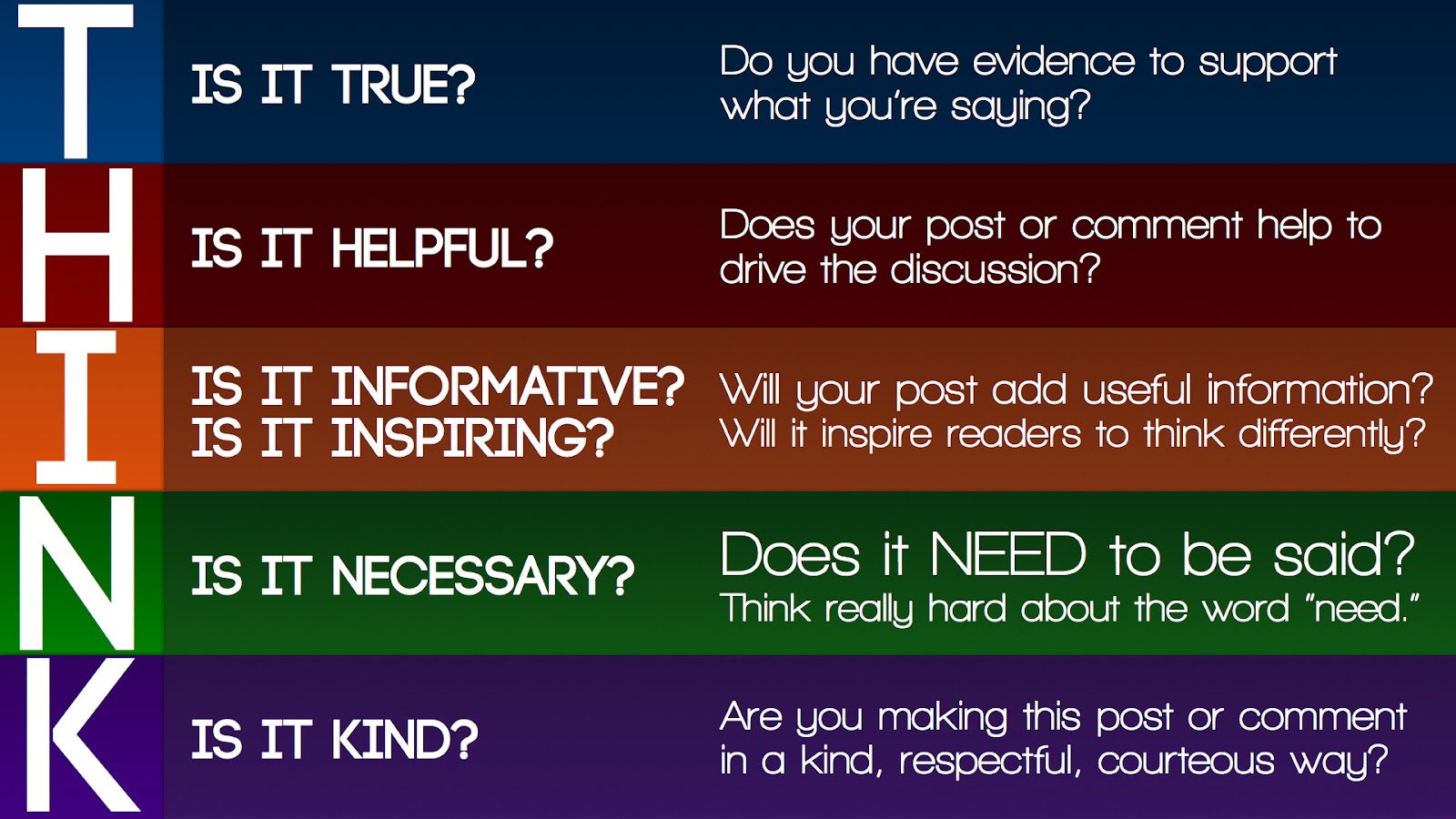
Perhaps our students and children are having such a difficult time being responsible with technology because role models are lacking. Often this isn’t intentional. While it is undeniable and unfortunate that there are adults who take to the Internet to be malicious and inappropriate, there are far more adults who take to the Internet without thinking before posting. I’ll leave you with my favorite resources on citizenship, Flocabulary’s “Oversharing” and this THINK poster:

think.jpg

Samantha Bates is a former middle school teacher and current Director of Member Services for Professional Educators of Tennessee. She enjoys spending time with her family and dancing like a crazy person when no one is watching.

Monday, February 16, 2015

How Does Excitement for Edtech Become Contagious?

Have you ever been to a sporting event and for whatever reason the crowd just wasn't into it? Maybe it was too hot, or too cold, or the score was a runaway, there wasn't enough excitement, or both teams played lackluster which caused the fans to be chatting in the stands or playing with their phones or people watching more than they were actually watching the event they had paid money to attend. I have been at those events. As a coach, player, cheerleader, rabid fan, or sports administration person the overall thought has to be "How do we change this climate?"
The same concept often holds true in education regarding technology. There are educators out there doing amazing things by using technology to enhance lesson plans but they aren't being seen, applauded, or even recognized! There is a new teacher out there- the one that realizes times are changing and constant access to information is here and  affordable wearable technology is right around the corner. According to a 2014 Pew report 83% of Americans aged 18-29 have smartphones. While this study did not ask anyone under that age, I know as a mother of teens, in my school community, the percentage of teens with smartphones would be exceptionally high as well (http://www.pewinternet.org/fact-sheets/mobile-technology-fact-sheet/).  There are teachers out there that are now trying to adjust their teaching to ask more "ungoogleable" questions, to change their teaching into "how do I teach these students to love learning, critically think, curate information, and use the information they always have in hand to make them smarter, well-rounded, individuals that add to, develop, and influence their worlds around them for good?" It's a question educators have been asking for years, "How do I best teach my students?" but the difference is that today's student has access to information on them all the time. According to my google search just now, "Google now processes over 40,000 search queries every second on average, which translates to over 3.5 billion searches per day and 1.2 trillion searches per year worldwide." (http://www.internetlivestats.com/google-search-statistics/). This tells me that people want to learn and are learning everyday in their least restrictive environment.
So why is it some educators just don't see the value of teaching students using technology? WE NEED MORE HYPE. No, not hype for hype sake...but teachers need to see how to make a good lesson better or a bad lesson good! Three times this year I have taken groups of educators to different schools and let them observe technology integration in action. Three times this year, those teachers have come back to our school and implemented something they were excited about seeing while at those schools. When teachers see amazing lesson plans using technology working, they feel more confident that it will work for them. When teachers visit enthusiastic tech-using teachers, when they have enthusiastic tech support, when they are praised by their administration for trying to enhance lessons using technology integration, when they have small triumphs they want to share with others, the excitement for Edtech becomes contagious. What can we do to grow this? Encourage teachers to ask others how they are integrating, encourage great integrators to share their ideas, allow teachers to visit other schools, give them the support staff to brainstorm new ideas, give them the culture to fail forward, hold their hands, invest, research with and for them. We need to celebrate beneficial edtech moments in their classroom and push them through the failures and fears of bad tech moments- both happen, just like good and bad lesson plans happen without technology. Visiting a teacher that is smiling from ear to ear because they have come to the realization that something about edtech makes them feel like they can "teach" or "reach" better is one of my favorite moments...those smiles are contagious- share them!