Showing posts with label learning. Show all posts

Tuesday, January 1, 2019

Top 10 Blog Posts of 2018

One of the things I love about posting my "Top 10" posts every year is seeing how much I've learned since they were posted. It allows me to see my growth educationally. It also allows me to see what others find interesting regarding what I do day in and day out. Without further delay here are my top 10 most read posts of 2018:
  1.  Changing the Conversation about Technology: A Teenager's Attempt - This is by far my favorite post ever. This post was guest blogged by a student at my school sharing his concerns about the impact technology is having on his generation. My most read post for 2018 actually became part of the curriculum in some of the English classes at our school this year. I'm thankful for Daniel's well-written attempt at being transparent about his journey with social media. 
  2. Authentic Embedded Professional Development? It's Possible - As an instructional technologist, I know that in-service days are limited. This post shows multiple ways I have created learning opportunities for our teachers in unique ways. From embedded into the day of all the students to supporting students hard work and learning from them. 
  3. Navigating Social Media as a Parent  - Being an e-parent is no joke. This post targeted parents by giving them some ideas to help them navigate the social media world for their children. I'm a firm believer that modeling appropriate digital citizenship using social media as a parent is one of the best ways to teach your child how to do likewise. 
  4. Embracing Myself as an Educator- like it or not.  - This seems to be a yearly blog post idea for me. Standing firm in my role as an instructional technologist when I feel like giving up. Transparency as an educator is important for teachers to both trust you and consider what you might be sharing. 
  5. Are Your Children Playing Fortnite Battle Royale? - Fortnite is one of the most popular digital games out there right now. This post was to help parents decide what boundaries (if any) they wanted to create for their children regarding the information shared. 
  6. Talking Social Media with Your Children -There was a time when I didn't believe any students should use social media. I don't believe that anymore. I think it is important to lead our children to use it in God-honoring ways. This is a blueprint to share with children to help them think about what they are doing digitally through a discerning lens.
  7. Why an LMS? Why Canvas? - This blog post comes from our school moving forward in using the learning management system, Canvas, robustly. The concept of this post is to understand the pedagogy in using an LMS and why I feel Canvas is a good choice for our school- an LMS we can grow into.
  8. The Value of Literature - This blog post is more of a personal journey post. After reading the book Wonder, I share my thoughts on its impact on me due to my own personal situations. The book reminded me of the beauty of literature and its far-reaching possibility of connecting authentic moments of our lives to our learning. 
  9. Lesson Revamps for High Agency Learning - As our teachers diligently started inputting their lessons and information into Canvas this year, I found myself thinking about how this timing could be used to better instruction. Technology can be used to digitize things as we have always done or it can be used to change things forward. This blog post suggests ideas for revamping lessons for the better.
  10. Alexa Blueprints- The Possibilities for Education are Growing  - Alexa in the classroom can bring up a myriad of feelings from different sides. As an educator that believes that there are some real benefits in voice user interface, I have hesitantly looked into these possibilities. Seeing this post reminds me it is time for an update on using Alexa in the classroom. Blog post coming soon! 

Saturday, February 10, 2018

When was the last time you learned something challenging, exciting and new?


I'm going to tell you a secret about me: I hate to fail- I don't do it with dignity. Because I hate to fail I often don't like to take chances either. As a child (birth to 18) I was fairly athletic and always loved to be active but place a new game in front of me or a concept I didn't know yet and I immediately became a wallflower. I would allow the fun to happen all around me while I watched because I was afraid I wouldn't be good at it. This is something that I have to be mindful about even today. I have to push myself out of this comfort zone and the older I get the more I find myself willing to fail, but it's still hard. My perfectionist and competitive tendencies sometimes overpower me.

In the past couple of weeks I've found myself truly pushed out of my comfort zone regarding learning. In one case circumstances caused the need for learning and in the other case passion to create caused it. I self taught myself the intricacies of 3D printing in the last couple of weeks due to a need my students had. I'll be honest, I haven't perfected this skill nor was I even 100% happy with the end results but I accomplished it. Next step: accomplish printing AND design.

The next thing I accomplished was creating my very first skill for an Amazon Echo. Alexa can now read my blog to all the millions of people interested (humor me) by adding the skill "All Things EduTechie Oriented" from the skill store. I was actually shook when I realized I had accomplished this task. My skill set was 100% lacking in trying this. The instructions often looked like greek to me. When I finished, just like a toddler that would run to mom and ask her to put their crayon artwork on the fridge, I started texting coworkers and family with the results! I'll be honest, I took the path of least resistance to create it. There are things about it that I wish worked differently, it isn't perfect. But I did it. 

I often like to think I'm a growth mindset kind of girl. I have no problem reading material that is contradictory to what I currently think and growing from it but it took these last couple of weeks to realize I do tend to shy away from truly learning the HOW TO of really new things. So as I look at what spurred me I also can't help but see correlations in ways we can spur our students as well:


  • Time. Both of these new skills took time. For one I actually put some things on hold and worked after school to get it done. For the other, the flu gave me the chance to just focus on it. We need time, uninterrupted time to think through things that are challenging. Adults and students need time to devote to learning and using that time intentionally is important for the learner to persevere.
  • Reason. Tell me they why. Before 2 weeks ago I didn't really even have a desire to do either of those tasks but now I'm pleased as punch that I have accomplished them. What happened to cause this? I had a WHY- whether intrinsically motivated or extrinsically motivated knowing why you are learning something gives you the guts to keep going when it gets rough.
  • Resources. To learn new things we need the access to the tools to get us through the learning goal. Whether it be the wide world web, an expert, or a 3D printer or Amazon Echo...you can't accomplish the learning if the right tools aren't available. 
  • Validation. This may sound vain but learners need validation. There was this moment when I accomplished the task of creating an Alexa Skill and someone ask "are you going to create it for Google Assistant as well?" I felt diminished in that moment. I said, "Wait a minute, can we just glow in the moment in the fact I did something I didn't think I could do?" How often do we push our students to the next thing after an accomplishment instead of truly celebrating the current accomplishment? For some of our students every math problem, essay, or summative assessment has that same sense of "Oh my goodness! Look what I just did!" as I felt this week. I want to be more mindful in celebrating growth in my students and not just seeing it as a check mark and herding them forward to the next thing. 
I love weeks when you learn something about yourself that you might actually even see as a flaw. I'm going to work harder in examining myself more frequently for things I might be shying away from due to fear. What I really learned from something that is challenging, exciting and new is that it feels marvelous (even if it isn't perfected) to accomplish that which you thought was hard to do. 

Sunday, April 23, 2017

Curation of Information: Harnessing the Beast of Ubiquitous Information

I have this crazy little habit that helps empower me every day for the educational tasks at hand. For the past two years I've taken part in the #OneWord movement and this year my word was "brave." As part of this year's word, everyday I have chosen some phrase and photo to put on Instagram to embolden myself for the day to be educationally brave to make a difference for students. Each phrase has #brave2017 in the comments. Some days I run across quotes that resonate with me, some days I write what is in my head, and some days I make a real effort to Google a theme or "educational quotes" and find something for the day.

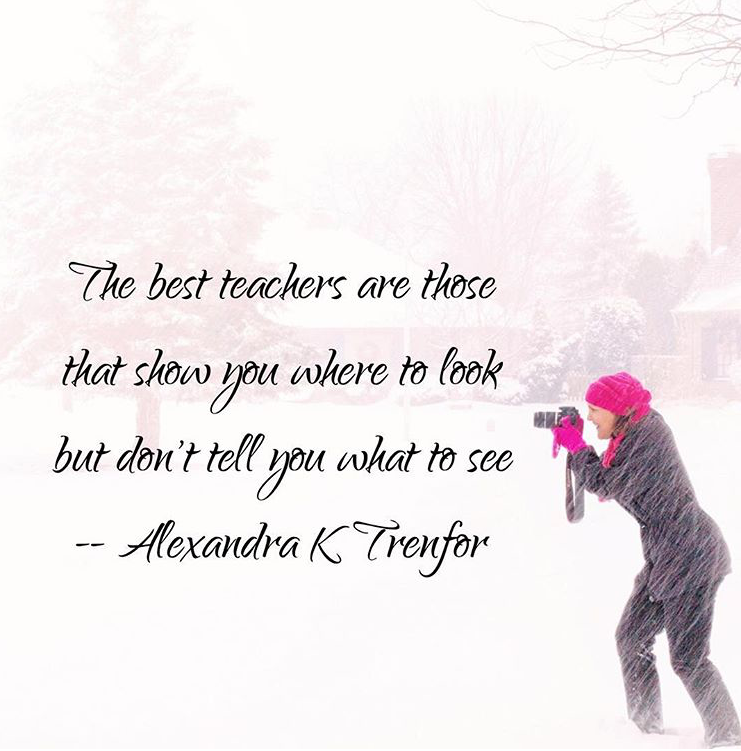
A quote that I have seen over and over on multiple occasion is the one in the image above: "The best teachers are those that show you where to look but don't tell you what to see." It is attributed to Alexandra K. Trenfor. Out of curiosity one day I decided to see who exactly this person was because I felt this little nugget of wisdom was so powerful. Imagine my surprise when not only I could not find anything about the person but found that other people had been on the same search. There is a bit of irony not lost on me that educators on a regular basis repost this quote and put it on educational websites and it can't really even be checked for authenticity. I mean, when I posted it I continued to attribute it to Alexandra K. Trenfor but I don't really know if that's right or not.

That left me thinking about the overwhelming need for curation of information in today's world. When we want to quote a website, oftentimes it is downright impossible to find the correct citing unless one uses an online bibliography that searches it from the URL and sometimes even then we come up empty handed.

Today as I was sick in bed I found myself digging around the internet looking for information on some topics I've been pondering and I came across this video that was uploaded in 2007. It's titled "The Machine is Us/ing Us." It speaks into the fact that WE are the creators of the web by the things we post on a regular basis, like this blog for instance. I am putting information out to a worldwide audience that might sway someone towards or away from a certain way of thinking about education. The "machine" is us but at the same time the machine is using my information, thoughts, and clicks to develop itself further. It's both alarming and intriguing to think of the power every John Q. Public has in the world today.
That being said, how do we as educators guide students to make ethical choices in what they claim as their own information? How do we guide them to best discern what is good information? How do we help them critically think about what they read and to turn information into knowledge? Especially when we ourselves are struggling with it as well. We are bombarded by fake news, wikipedia, and find ourselves searching snopes.com for discernment but I'll be honest some days I still don't know what is real or not (especially in regards to politics lately). We are being manipulated by our clicks as to what "real" is to us and yet we also have access to great information that allows us to learn anything we want to at the typing of a few key words. While we struggle with the shotgun method of information that comes at us regularly we must learn alongside our students how to best manage this resource. I don't want to be seen as a machine but I do want to know that I am adding value to the machine. I want my students to experience that as well. The ubiquity of technology cannot be ignored but it can be used for good.

Thursday, April 13, 2017

Lessons Worth Remembering

What makes a lesson worth remembering? It's been a VERY LONG TIME since I was in a k12 school as a student but I have been spending time trying to remember actual learning lessons. I'll be honest, there are very few "lessons" themselves I remember anymore and what I have come away with is that in order for me to truly remember a lesson one of the following had to happen:

  • I had an ongoing relationship with the teacher. I remember lessons and/or teachable moments with teachers that knew me as a person- my biology teacher that I babysat for, my history teacher who was my friend's dad, my psychology teacher that I also was a teacher's aide for and we talked about life during that time, and my business education teacher that I went to church with. 
  • The lesson was not the norm. It was kinesthetic, hands-on, not "sit and get." I remember learning how to do a Rubic's cube in 7th grade math class. I remember dissecting a frog in biology. I remember my geography teacher pretending our desks were planes and we would look out different windows to learn where different countries were in relation to each other. 
  • It was a non-traditional way of showing my learning. I remember researching/creating my science fair project for 7th and 8th grade that was on the topic of the value of holistic herbal remedies. I remember creating an emergency first aid/wilderness box in 6th grade before a week of outdoor learning at Rock Eagle. I remember being asked to sing something to see if I could reach a certain octave to try out for a solo.
  • It caused an emotional response of pride or embarrassment. In 5th grade I remember my art work being chosen as a basis for the mural going down the hallway in my elementary school and I got to be pulled out of class to help paint it. I remember being chosen in 12th grade to take Accounting 2 even though it wasn't a class being offered and it would be me doing it on my own during a typing class that the business ed teacher was teaching. I remember being chosen to be on the 9th grade yearbook team. I remember taking 12th grade dual enrollment english and my professor recognizing an open letter assignment I had written and him reading it to the entire class because it was well written in his eyes, but I also remember that same professor leading a discussion on the wife of Bath in the Canterbury Tales and discussing the importance of her gap-toothed reference and me being mortified because I had a gap between my two front teeth. 
  • The class had good whole group dialogue. If a culture of safety in sharing existed, I remember those discussions. I remember the value of hearing the thoughts of my school mates. I remember sharing my own thoughts on subjects and believe it or not, I was shy. It took a LOT for me to add to conversations. 
  • If more than one of the above happened in a classroom I am more likely to have even more memories. For instance, I can remember word for word lessons in classes where I felt a connection to the teacher and felt empowered by the way the classroom dynamics were.
So what does this mean? As we are planning forward in creating both scope and sequence and lessons for next year, I find myself thinking on the value of recognizing positive achievements in my students, creating opportunities for learning that allow them to use different modalities of instruction, being intentional in knowing the students I'm working with and their likes/dislikes even if it is just about the lesson at hand, and creating a culture where students feel safe to be transparent in their learning- where failing is a learning opportunity and collaboration is safe. I don't remember ever having the opportunity to participate in project based learning or solving real world problems. I wonder what that would have done to my processing? 

And then I find myself asking...Should all lessons be memorable? Is there value in the mundane? What would students say? Can there be too much engagement sometimes? and finally...How do we define the process of "what makes a good lesson?" What role does technology play in all this today?

Saturday, February 4, 2017

Finding the Student/Teacher Ratio Sweet Spot Through Blended Learning


I don't teach technology. I teach rethinking education. Jesus thought that a teacher to student ratio of 12 to 1 was good. I'm of the theory that He should know. If that's the case, what can I do to help teachers find that sweet spot. Leveraging technology in the classroom through blended learning can help do that. 

Let's face it, the higher the student to teacher ratio the lower the cost of education. Less teachers teaching more students is a financial win but not necessarily an academic or emotionally supportive win. Life is about connections. When people connect, magic happens...if you don't believe me watch any movie on the warm and fuzzy Hallmark channel. 

Connecting with others creates a feeling of safety to be one's transparent self. Transparency leads to trust, trust leads to growth, and growth leads to success. Label "growth" whatever you want to- better grades, better skills, better level of adaptability- growth isn't always easy but  it is always rewarding to see it in others or be able to acknowledge it in ourselves. 

I don't teach technology, I teach growth. Technology is often my avenue for this but I didn't come into the world of education to push technology, I came into this world to make a difference in student learning. 

The exponential changes that education could conceivably go through in the next 3-5 years is mind boggling. I remember leading a group of sophomore teachers and department heads a few years back and the last words out of my mouth were "Be mindful that the next big thing is adaptive technology. Keep on the lookout for it. It will have the potential to change education as we know it." 

Cue now... in multiple areas of our school I see the use of adaptive technology for students to practice ongoing learning. If the problem is too hard and they get it wrong, they can see the right way to do it immediately and the next problem will be easier. This creates a feeling of success in learning. Digital scaffolding is better than any "do odd problems on page 27" could ever be. Immediate feedback on results, immediate reteaching on subject matter, immediate second chance to try again. 

So what? This type of technology becomes a teacher in itself. That makes some people scream in pushback "no, you just said education is about connection!" Bear with me... efficiencies in teaching by using technology like I mentioned allows the teacher more time to connect. It allows the teacher more time for small group and one on one lessons. It allows the teacher more time to go deeper. Not only does this type of technology give students immediate feedback but it also gives teachers the efficiencies of knowing what should be next, who is ready to move on, who is not. 

Adopting a blended learning model that includes adaptive technology allows quicker insight for the teachers because of the technology itself but also because small group instruction lends itself to being more aware of individual student needs. 

There is no magic software or perfect way to do this. All blended learning classrooms look differently. I am a firm believer that leveraging blended learning in today's classrooms is creating the type of students that will be successful in tomorrow's real world jobs. The soft skills of self-motivation, collaboration, critical thinking, communication, adaptability, accessing and analyzing information become even more imperative in a world where access of information is always in our back pocket. 


Today's ability to transform a single classroom into differentiated teaching styles by choices like teacher facilitated, digital instruction, gaming, inquiry based learning, hands on, or peer to peer creates an adaptable student that can not only turn a pocket full of information into knowledge but also creates a person that sees the value of progress. And maybe just maybe we empower them to desire to be lifelong learners along the way. 

Friday, January 27, 2017

My Game Changers from FETC

Coming to FETC for the first time has been a major highlight of my edtech career. Being surrounded by great educational minds and both growing relationships and learning is one of my favorite things to do. I love how this conference is set up on tracks and how it actually has helped me realize just how much I think about where education is going and how I can best support it.


As I think about what I've learned to bring back to Chattanooga, Tennessee I'm feeling passionate about these things specifically:

1. Having the honor to attend the Future of IT Summit for two days prior to the opening keynote was an awesome opportunity. I attended a panel discussion on procurement of technology and the CIO of the Tennessee Department of Education was there. As he spoke on the way Tennessee works to leverage pricing for all districts no matter how big or small I thought "too bad that doesn't include private schools." Afterwards we met and he told me it does. I can't wait to get back home and contact him to see if this will benefit us at CCS. 1 hour in to being at the event and I learned about this- what could be a game changer for us.

2. As I walked the expo floor I saw two or three different options for throwable  microphone balls. Having a student in our elementary school with cochlear implants, this could be a game changer for her in hearing her fellow students in the classroom.

3. On a regular basis at our school there is a lot of talk about whether note-taking on devices is a good thing. When one of the Vice Presidents of Microsoft shared their white papers on digital inking I got excited to read the research. I have no idea what it says yet because I haven't had the chance to read it but research in this area could be helpful in changing some mindsets.  https://www.microsoft.com/en-us/education/educators/digital-ink/download-whitepaper/default.aspx

4. Since going 1:1 I have struggled with the fact that the administrators at our school have not necessarily been equipped to know what to look for in terms of digital learning in their walk thrus. Listening to Steven Anderson share about the new ISTE admin standards and what a walk thru should look like made me want to scream "Yes! This!" And the beauty of it all is that he has shared his presentation with us all so I can come back to school and share it with our administrators. This concept has been working in my head for months but he just took the prep work out of my hands. This can be both a game changer for our admin in that they will feel more equipped and our teachers in that they will know what is expected.

5. Having the opportunity to present with Greg Bagby is always a pleasure. Talking afterwards with some of the 200 educators that attended our session was a personal game changer for me. Hearing how others relate to what you've shared or wanting to share something with you is a beautiful thing. It both affirms and grows me. It also reminds me that I am fortunate to be doing that which I am passionate about in life. Not everyone has that luxury.

These aren't all the things I've learned by any stretch. I go back home today with an edtech toolbox full of new ideas. I'm thankful for this opportunity to grow relationships and myself. I'm thankful to have spent the last few days surrounded by likeminded thinkers...to listen, reflect, disagree, and/or embrace new ideas.

Friday, April 29, 2016

Did we win?


Today as the elementary school ended its  field day with the ever famous grade level four way tug-of-war, like always I played my obligatory role of chief encourager of a team. This year it was team green... As each grade stepped up to the four-way rope and pulled their hardest I yelled "let's go green machines!" "You can do it!" "Dig in" etc. and inevitably my team didn't win and I sent team green back to their seats with high fives, "great jobs" and "it was so close!"...And then the fifth grade came. They pulled with all their might and they are actually experts at this because they have been doing it for years now. They came with gloves on, a plan of attack, and a thirst for victory. At one point it was so close to a victory for my beloved green team but alas when the whistle blew there was a pile of green on top of each other and two kids looked up at me and said "did we win?" I said, "No, I'm not sure who won but it wasn't us." To which one girl replied "WOW, IT REALLY FELT LIKE WE WON. I REALLY THOUGHT WE HAD."

I've been thinking on that all day. She was trying so hard, was so caught up in the moment it felt like she had won. And truthfully I was so caught up in the moment of encouraging those green machine kids I wasn't sure who had won.  Isn't this what learning should look like all the time? Students so caught up in the process that they may not even realize the end result when it happens? And teachers so caught up in their students that the end results are really superfluous to the path itself? 

I find myself being more and more challenged to create learning environments like that. As I study the value of formative assessments over summative assessments, competency based learning, personalization, and student voice and choice I imagine students so caught up in the learning all else fades away. I imagine driven behaviors because students are excited about what's before them. Is this a bunny dream world? Maybe a little, but I believe schools are not around for grown ups to have jobs but for kids to learn and succeed. If that's our first priority, what might happen?

Tuesday, January 19, 2016

5 Easy Peasy Options for Tech Integration


There are some ways to integrate technology in your classroom that adds value to your learning environment and pretty much can be a go to no matter what the lesson plan. Here are my favorites no matter what grade level you might teach:


  1. Research.
     Allowing students to find information on a topic by themselves allows them to delve deeper into areas that appeal to them. It also allows them to be in charge of the path of their learning no matter how "locked down" the requirements for the lesson are. Most school systems have access to online research databases that are grade-based helpful. Teaching students how to curate all the information on the internet is no easy task but placing good research options in their path helps. Using digital encyclopedias and search engines like http://kiddle.co for younger students can help. 

    Showing older students how to use the Google search engine tools (http://mashable.com/2011/11/24/google-search-infographic/#0vBxYjxrxsqb)as well as how to use your library's digital learning databases are important steps to preparing our students to learn how to find quality information with ease.
  2. Mind mapping.
     
    This article talks about the benefits of mind mapping: http://mindmapsunleashed.com/the-mind-mapping-concept-and-how-you-benefit-from-this. There are many free or almost free websites and apps that allow students the beauty of gathering their thoughts on a topic in a systematic way. Apps like Popplet and Simple Mind+ and websites like www.mindmeister.com allow students the ability to creatively make connections to ideas, discern important points, as well as map outlines for papers. Mind mapping has also often shown a benefit to recall as well.

  3. Collaboration.
     
    My favorite way to collaborate is using GAFE (Google Apps for Education), specifically Google Docs so that students can collaborate on writing projects through the use of multiple users on one document or even just allowing collaboration on a document by the adding of comments for reflection. There are also options like Padlet, Google hangouts, Skype, blogging, and the discussion boards of your school's LMS options that either allow students the ability to connect with each other or the world beyond the four walls of their classroom. 

  4. Whiteboard options.
    For years teachers have used whiteboards for quick formative assessment to see if daily learning objectives have been met. Today, we have websites and apps like A Web Whiteboard, Explain Everything, ShowMe, and EduCreations that can be used to give students personal access to content. Digital whiteboard options also are a great tool to allow students to use at the end of a class to show their learning for the day as well. Finish your lesson, tell the students to open their Digital Whiteboard and say "create a file that shows me the top three things you learned today in class," or "Create a math problem using the formula we used today and solve the problem." The possibilities are endless. 
  5. Studying aids.
     
    Technology is a great way to aid students in studying. Digital flashcard makers like Quizlet and word cloud creators like Wordle are a great way for students to reinforce spelling and vocabulary terms. Khan Academy, ck12.org, and other online options as simple as youtube offer your students additional support in studying for exams or refreshers for homework. 

    The options for integrating technology into the classroom are endless and the creative ability to what a teacher hopes to accomplish is turning more dreams into reality every day. Technology often affords the teacher extra time to have more one on one opportunities with their students as well as supporting the learning environment in very concrete substantive ways that didn't exist a decade ago. The above 5 options could easily be adapted and adopted in any classroom to reap the benefits of technology in our schools and to equip our students for the world beyond their academic life.

Thursday, September 10, 2015

What About Blended Learning?


As we are now 4 weeks into an eighth grade math blended learning prototype at our school we are hearing things, we are experiencing things, and we are learning things. We've started, adjusted, moved forward, and camped in place for a few days. We've listened, we've researched, we've visited, we've adapted. These are things teachers do in any class- whether traditional or blended. Good teachers adjust their teaching to their students needs. As a technology coordinator, this is what I have learned 4 weeks in:

1. A need to explain expectations well. Our students are submerged in a traditional school environment, this model of learning is very different for them. Being in control of their pace, learning that homework doesn't necessarily happen with pencil and paper, and using time in class wisely have been either new concepts or concepts being leaned on more heavily than ever before. Some of these kids seem to have the "mind blown" look in their eyes as they enter into a collaborative-based learning environment with strange looking desks, 3 teachers in a classroom, stations, and technology.

  • We thought we would just let these students be "self-paced" and we may eventually get there but we quickly learned that eighth graders need CHECKPOINT EXPECTATION STRUCTURE. Perhaps it's because it's all new but we have set some progress check points so that we can make sure they are on track.
  • Some zeroes had to be placed in the grade book to remind students "this is for real." They are adjusting, but just like a traditional classroom some kids lag behind based on bad priorities of getting things done- not just ability. Those things are being addressed.

2. Pacebreakers are seen quickly. The ones that struggle to understand and the ones that can just go on ahead show themselves and their learning can be adjusted for much earlier in the classroom than in a traditional environment. Coming up with a plan has been a bit more tricky because this is a prototype and there is no "plan" for those with the ability to zoom beyond Intro To Algebra within the year and we have to keep the stragglers on target to finish the class in the school year as well.
  • Having 3 adults in the classroom has made it easier to small group instruct those students that need additional help. The adults have also taken advantage of some available daily RTI time built into the school day.
  • Using technology has allowed students to move ahead a bit from the pack as well. In a traditional setting, these students would be sitting there waiting for the teacher to address the issues for the majority of the class and they wouldn't have had the ability to do anything but wait and possibly aid their friends in peer-to-peer tutoring. These students can also have the ability to go a bit deeper with projects or tasks that show critical thinking of concepts beyond the norm.
3. A base for good resources is a must. Giving teachers time to create their own videos, places to go to look for additional resources, and a flexible budget to adjust to standards is needed. For instance, we have been using Khan Academy as one of our main technology-based instructional options but the upcoming unit doesn't seem to have as many good videos and problems as we have had for the last 2 units. We plan to adjust by buying something. 
  • Last year, before the project was actually being implemented I spent some time looking into various technology-based options. This list came from that research but I find it to be ever changing with the hardest problem being me finding the time to research more and more. 
  • Using something like educanon.com or edpuzzle.com to take a pre-made video resource and allow the teacher to personalize it is also a great way to personalize resources for a certain environment.
4. Standards-based assessment with blended learning could open the door for true personalized learning to happen and for future teachers to know exactly where the gaps are for students next year as they could see "this student is not proficient in these concepts" or "this student is proficient beyond the concepts of this class, dig deeper!"

  • Using a new LMS called Edify has had its challenges but what we are seeing is what value there is in standard-based assessments. We now know what concept a student still isn't getting with a quick look instead of just seeing a grade. While we have not been able to use this to it's full potential, I see amazing capabilities. 
  • We have to start with the standards and work backwards, not start with a curriculum and work towards the standard. Expecting teachers to work from a curriculum forward greatly increases the amount of work they have to do to reap the benefits of standards-based learning.
  • With standards-based learning, the next teacher would know exactly what concepts a student struggles with not just "Suzie is historically a C+ student." Standards-based learning is a longterm continuous key to personalized learning for each student throughout their educational life if handled appropriately. While we aren't "there," I want us to be there and reap the benefits! 

Looking forward to what this means for the future!


Monday, April 20, 2015

Should ALL Educators Be Innovative?


For the last few days I've been thinking about the definition of innovation and the place it has in education. I may be an EdTech person but I'm a "wordie" as well. I believe in the importance of words used well. It's why I feel adamant in choosing the words "facilitator" or "coach" over "para-pro," and "lead" over "master." It's why I dislike the word "rigor" and get so livid when I hear the word "fart" that I write blog posts about it. I need a definition to a word that I can wrap my head around and I need to know what it means to others. In education, you hear the term "buzz word" a lot. "Innovation" is the latest buzz word or "fail forward" or "personalized learning." I'll admit, I've reacted strongly against some words but often it's because my definition does not match that of the speakers. Being a wordie is probably why I like to blog as well.

So today's word in question is INNOVATION and it's place in education. At a meeting I was in last friday with educators and computer programmers a comment was made that "innovators find each other." It got me thinking...what is an "innovator?" So I pulled up the definition that said, "1: the introduction of something new. 2: a new idea, method, device" and in my head, it became the place where passion and need intersect. I have been accused of being a passionate educator on several occasions, and quite frankly I take it as a compliment (I'm not sure it is always meant that way). Because I am an instructional technologist, I think about how technology can aid the path of learning far more than I should. I stand firm in my belief that technology in the classroom can revolutionize the way students learn. I passionately try to convince the naysayers and I dig deep to find ways to prove the worth. What I enjoy the most is when I see a need and get the opportunity to look for ways to meet that need with technology. Like the figure above- when my passion for EdTech meets the needs of students, innovation occurs often. 

Does innovation have to be technology based? I don't think so. Technology doesn't have to be the only option of meeting a student's needs. Perhaps it means teaching a student how to take efficient notes by training them in some way using both visual drawings and words to stir remembrances. In that case, technology doesn't have to be a part of the equation. (Did you see how open minded I was with that idea just then?). What I do believe is that innovation works with an overarching cover of creativity. I believe innovators are creative souls. I believe the passions they have for their disciplines lead them to creatively think about how to best reach their students. I do not believe innovation and creativity can be separated. I do believe even non-creative types can see the benefit of innovation and want to use it. I do not believe non-creative types will be the ones that have that lightbulb moment of "Heyyyyyyy, what if we could make this happen!"

So what does this theory I have mean to education? When we place people in roles, I think it is important to decide what the level of innovative thinking needs to be for the job at hand. Are innovators also design thinkers? Perhaps this is also true. Are innovators risk takers? I think that is probably the case as well. So as educators, what positions require this type of personality and what positions don't? Is there a difference? Should there be a balance? Should ALL educators be innovative? I leave you with questions that I choose not to answer but would love to hear the thoughts of others. "Hmmmm moments" are some of my favorite to ruminate over. This is mine for today.