Showing posts with label plagiarism. Show all posts

Saturday, December 15, 2018

What is Cheating in the Digital Age?


For the past few weeks, I've heard the laments of teachers worrying about cheating. For some, it's because they are actively aware it is happening in their classrooms. For others, it's because they have heard it is happening in someone else's classroom. As I hear what others are saying I am appalled by some of the blatantly sneaky cheating that is going on by students but I also am aware of a gray area that seems to blend the lines between right and wrong. So I ask, what is cheating in this digital age? The following blog post isn't about me saying that cheating is ok, it is about my view on why it is harder than ever before to keep a student that wants to cheat from cheating. Here is my opinion why it seems more acceptable to students to work the system:

  • Hacking is acceptable and seen as a skill. Today we are training students how to code starting in preK because the future wants this skill in the workplace. According to the Techopedia website, hacking is the ability to break into a system (https://www.techopedia.com/definition/26361/hacking) but every single day as an instructional technologist I sit at my desk and wish for different educational platforms to be able to do certain things they cannot and I look for add-ons (or hacks) to make it happen. For instance, at our school, we use the LMS Canvas but it doesn't inherently lock a student into a quiz tab while taking a quiz so we have bought the "hack" known as Respondus Lockdown Browser as an add-on to do this. There is a little bit of irony that the hack is to prevent cheating but in this case, Respondus is what is known as a non-malicious hack that adds value to a product and the product readily accepts it. But do you see the irony? 
  • We are teaching students to find tools to help them in their learning. Today's students have not ever lived without the Google search engine. This means that today's students are not dependent on their teacher to pour information into them. Part of teaching today is helping students discern tools that aid their learning. Maybe it's Khan Academy for a math concept or as I type on this blog, maybe it is Grammarly. Grammarly is a writing assistant that helps you correct grammar mistakes as you type. To me, even the free version is one step beyond the red squiggly underlines of word processing software. With one click, I can add Grammarly as an extension on my Chrome toolbar and I have a benefit the person sitting next to me does not. AND if I happen to have $12/month the benefit for the paid version can truly change the way I write by leaps and bounds. But what if a teacher is grading my grammar on an essay, is this cheating or is this using the tools available to me?
  • Everyone else is doing it. Yesterday I had a conversation with a super vigilant parent that works hard to create safeguards for his children not to access parts of the internet that can lead to moral degradation. After realizing his boys were accessing gaming time more than he had set up to allow through their Disney Circle he dug a bit deeper. His boys had downloaded an app that allowed them to bypass the VPN blocks so that they could play Fortnite longer than their father deemed healthy. When asked how they knew what to do..." everyone at school does it." The father said to me "and I have good kids!" and he does. If this is so rampantly accepted by this generation how do we harness it? How do we protect ourselves from ourselves? Or more importantly, how do we protect our children as they are developing their frontal lobe from themselves?
  • There doesn't seem to be ramifications. Kids aren't getting caught. This week I heard of two students laughing in the hallway about turning in a slideshow they had pulled off the web, changing one page and then turning it in and getting an A for it. I also heard about some students cheating on exams in a classroom on a regular basis since the beginning of the school year. If it seems like people are getting away with it then the effort to do right seems pointless. Of course, this opens the door for a lot of edge-pushing discourse. Perhaps the concept of grades need to go away? Or what feels like high stakes testing? And then there is the fact that our school's average ACT scores keep going up so if students are cheating but those type of scores continue to go up where is the disconnect? And is it that the students see the disconnect better than the educators do? I realize all those questions could be read as heresy but like I said, this blog post is to help me put all the cards on the table and honestly look at what is happening.
  • The rules of plagiarism are harder to distinguish. Not just for the student but for the teacher as well. My college-aged student just finished a class in British Literature where she made a 50 on a project because the teacher said she plagiarized. That being said, she still doesn't believe she did because she had sources on every slide. Quite honestly, I'm not sure she did either. And there is the rub. The ease of access to an abundance of information makes it harder and harder for teachers to distinguish the work of their students from someone else. It also makes it harder for students to discern if that was an original thought they just wrote in their paper or if it was something they read in the last 2 hours when perusing one well-written article after another during their research phase. 
  • Access to information makes some tests seem irrelevant at best. And this is the bullet point that will get educators ruffled more than any other. Are we still testing our students as if they didn't have access to technology? In my lifetime of learning, there was value in rote memorization questions but if I can google an answer in 2.7 seconds is our question relevant in today's world? Perhaps it is time for us to evaluate our evaluations. Can we assume students will always have access to information and test them in a way that shows they have turned that information into knowledge? Critical thinking questions based on information readily available. Or authentic learning opportunities, project-based learning, inquiry-driven learning etc...all seem like buzzwords but we are in a time in education where discerning if learning is actually taking place is getting harder and harder to do. How do we change our method of operation to meet the needs of today's student so that cheating doesn't seem like the most logical way to deal with a test at hand. How do we change our questioning to force students to think about their answers instead of googling their answers? 
  • What happened to honor? How do we instill in students the virtue of being honorable in regards to testing integrity? What digital citizenship lessons need to be talked about in every classroom to show the level of importance we place on this? What expectations need to be placed on the student? What ramifications? And while we are at it, what expectations should be placed on the educator to do their part in creating an environment where integrity and honor are both expected and monitored for? 
What is cheating in the digital age? It might seem black and white to you but to our students, it is becoming more and more of a gray area. We can't ignore this. Important conversations need to be happening so that important outcomes can be produced. 

Sunday, April 23, 2017

Curation of Information: Harnessing the Beast of Ubiquitous Information

I have this crazy little habit that helps empower me every day for the educational tasks at hand. For the past two years I've taken part in the #OneWord movement and this year my word was "brave." As part of this year's word, everyday I have chosen some phrase and photo to put on Instagram to embolden myself for the day to be educationally brave to make a difference for students. Each phrase has #brave2017 in the comments. Some days I run across quotes that resonate with me, some days I write what is in my head, and some days I make a real effort to Google a theme or "educational quotes" and find something for the day.

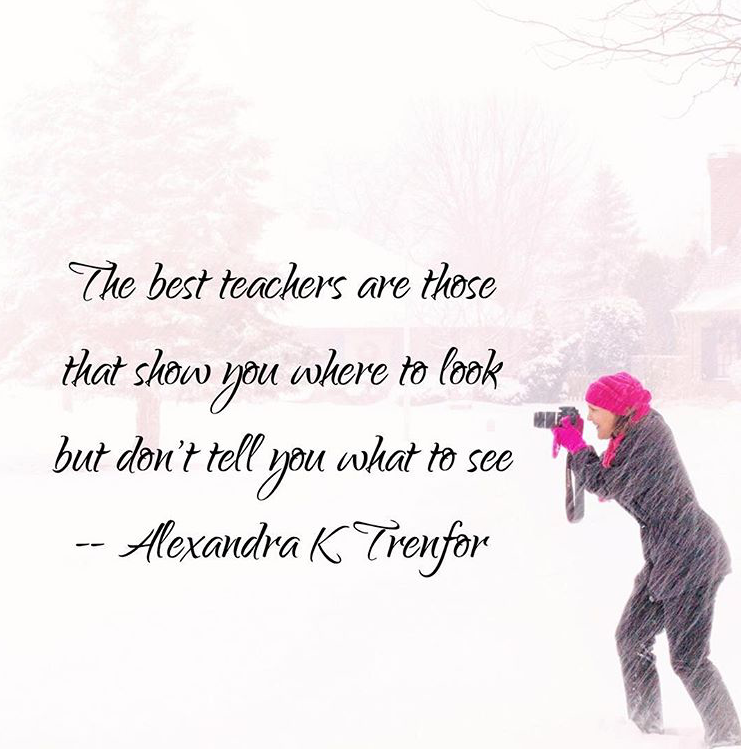
A quote that I have seen over and over on multiple occasion is the one in the image above: "The best teachers are those that show you where to look but don't tell you what to see." It is attributed to Alexandra K. Trenfor. Out of curiosity one day I decided to see who exactly this person was because I felt this little nugget of wisdom was so powerful. Imagine my surprise when not only I could not find anything about the person but found that other people had been on the same search. There is a bit of irony not lost on me that educators on a regular basis repost this quote and put it on educational websites and it can't really even be checked for authenticity. I mean, when I posted it I continued to attribute it to Alexandra K. Trenfor but I don't really know if that's right or not.

That left me thinking about the overwhelming need for curation of information in today's world. When we want to quote a website, oftentimes it is downright impossible to find the correct citing unless one uses an online bibliography that searches it from the URL and sometimes even then we come up empty handed.

Today as I was sick in bed I found myself digging around the internet looking for information on some topics I've been pondering and I came across this video that was uploaded in 2007. It's titled "The Machine is Us/ing Us." It speaks into the fact that WE are the creators of the web by the things we post on a regular basis, like this blog for instance. I am putting information out to a worldwide audience that might sway someone towards or away from a certain way of thinking about education. The "machine" is us but at the same time the machine is using my information, thoughts, and clicks to develop itself further. It's both alarming and intriguing to think of the power every John Q. Public has in the world today.
That being said, how do we as educators guide students to make ethical choices in what they claim as their own information? How do we guide them to best discern what is good information? How do we help them critically think about what they read and to turn information into knowledge? Especially when we ourselves are struggling with it as well. We are bombarded by fake news, wikipedia, and find ourselves searching snopes.com for discernment but I'll be honest some days I still don't know what is real or not (especially in regards to politics lately). We are being manipulated by our clicks as to what "real" is to us and yet we also have access to great information that allows us to learn anything we want to at the typing of a few key words. While we struggle with the shotgun method of information that comes at us regularly we must learn alongside our students how to best manage this resource. I don't want to be seen as a machine but I do want to know that I am adding value to the machine. I want my students to experience that as well. The ubiquity of technology cannot be ignored but it can be used for good.

Monday, March 27, 2017

The Value of Googleable Questions?


In 2006 my oldest daughter was in 4th grade and part of the curriculum was called "Daily Oral Geography." This is a well known geography curriculum that consists of weekly worksheets to teach geography. I remember buying Jessica this huge Atlas that was a bound book. We still have it because it was so nice. She could look up all sorts of maps to answer her questions. We spent a little extra for it but decided with another child 3 years younger, it would be worth it.

I remember one night Jessica was working on her D.O.G. (Daily Oral Geography) as homework and she came downstairs and asked "Mom, it asks what the 5 oceans of the world are but I see more than 5, can you help me?" I looked at the atlas and saw what she was talking about. At that point in her school life, she didn't have easy accessibility to technology. She didn't own a smartphone or iPad because they were not yet invented. We had a family computer but it wasn't seen as a place to go to help with homework.

I remember googling "5 oceans of the world" and one of the first hits was the actual worksheet she was doing all filled in by a teacher. I said "wow!" and Jessica looked over my shoulder and said, "YES!" to which I replied, "You can't just copy the answers." And she didn't. She worked hard to get her answers every week. It was a moment to teach good digital citizenship at my house but it also led me to start thinking deeper about what we ask of students. I didn't expect to find the actual worksheet on the internet and I'm sure her teacher didn't either. There is no blame in this statement, just a fact...I saw the world changing.

This was 2006, 11 years ago. Educational technology was not even a strong game at that point. Out of curiosity I just now googled the same question and in 1.75 seconds I had 1,340,000 results with the first hit being them listed in bold with bullets. What does this mean to education?

I find myself seeing this from several different angles:


  • Students becoming positive Digital Citizens. If you are a user of technology, you are a digital citizen- a participant of a community with rules and expectations that are constantly evolving. With educational technology comes faster access to information and opinions. In 2006 the ease to get to "facts" using technology was just the tip of the iceberg. Now that educators are seeing the value of students having authentic audiences, we are suggesting to students to create an online presence of their learning. No longer is it just facts that can be googled but also opinions of other students across the world. With the mapping of curriculum (which prevents gaps for students if they leave one district for another) being somewhat the same from district to district the ability to find answers to the assignments placed before students becomes easier and easier. More than ever before it is important for us to set well explained boundaries and expectations for our students. When is it ok to use technology for learning and when is it not? Teaching students the value of the process of learning, not just the end results on a worksheet for a grade is important because when I google "write my paper" I have 212,000,000 hits in .42 seconds. To think our students are not doing things like this is naive at best. Spending time in each class setting digital citizen expectations is crucial to helping students navigate and choose to be students of integrity.
  • Teachers asking intentional questions. More than ever before I think it is imperative that we look at education differently. Access to information is at the fingertips of our students (even in elementary school). When do we, as educators, ask easily Googleable questions? When do we allow technology to answer those questions for our students? How does homework fit into the easy accessibility of answers in today's world? What information is now "worth" memorizing? Who decides what required facts to purge in this day of easy accessibility? How do we make sure students are truly answering from their knowledge bank and not their ability to ask Google good questions? What's the value of worksheets in a world where you can find the answers and fill in the blanks in about 3 minutes? How do we make sure students are learning how to use tools beyond technology? When are shortcuts ok? When are they not? If Google can answer a question, is it a worthy question to be asking our students in preschool? elementary? middle? high? advanced?
  • School Culture changing to adopt more critical thinking goals. Does technology mean we should be rethinking the way we teach? In the past, the teacher was the giver of all knowledge. Now students are both learning and creating in their own way, on their own time. Does this mean we need to be looking beyond the practical and pushing students to critically think about that easily accessible information? Is this why project based learning, cross-curricular integrated units, genius hour, and personalized learning is becoming significantly more popular? Is this why schools are trying to shift away from grades-based learning to competency-based learning? Is there a better way for students to prove their understanding not just their compliance to educational norms?
I'll be honest, even as an instructional technologist, I find the possibilities for education in the future mind boggling. I want to make sure we are being student centered as we adopt and adapt education. I don't want to throw out the baby with the bath water but I also want to know we aren't accepting antiquated ways of doing things "because we've always done it this way." And so I ask the question again..."what is the value of Googleable questions?" and "What new expectations should we be placing on students?"