Showing posts with label internet. Show all posts

Saturday, March 10, 2018

Giving Up Privacy or NOT in the Digital World

For the last few weeks I've been given opportunities of learning that have made me rethink technology in a number of ways. As an instructional technologist I probably own my responsibility of being vigilant about the tech I put into student hands more than would seem normal. In fact, I might possibly own it in an obsessive way at times but I feel that's part of my responsibility of being a key player and decision maker regarding digital learning at our school.

One of the big things that I've been thinking on is privacy issues. As I've been looking at the abilities of iOT, watching the youtube series from the Common Sense Media "How Tech Has Hooked Kids," and trying to continue to be on the cutting edge of knowing when good tech options are on the horizon some flags have been raised for me personally.

I'm going to be really honest here, I rarely read the Terms and Conditions for apps or websites. I obviously keep in mind the importance of COPPA (the Children's Online Privacy Protection Act) when creating opportunities for our lower school students. Teachers of elementary and middle school students have to be vigilant in how they introduce technology to kids. And the truth of the matter is, we often have to pass on some really good fits because of COPPA. It's a give and take in the digital arena.

But in the last few days I started asking myself what do I do to protect my own privacy? Honestly, when I hear about an app that I think might sound interesting for educational purposes, or students are trying for social reasons, I tend to immediately download the app, make an account and do some research and development...cue yesterday.

A few weeks ago I downloaded an app called Vero- it's self-touted as a social media app with the tagline "Less social media, more social life. Behave online as you do offline." This app isn't regulated via an algorithm like Facebook or Instagram so it lets the user see their friend's posts in a sequential order. I saw some of my educator friends talking about it on other social media and decided I needed to download it and take a look. The truth is, I didn't immediately make an account- it's been sitting there on my phone waiting. So last night, after two days of talking about privacy issues at an iOT Escape Room Workshop I decided to research the app before creating my own account. So I innocently googled "What do we know about the App Vero?" and imagine my surprise when the first hit was Time Magazine and basically the same title- Vero: What to Know About the New App and its CEO.  It's a worthy read and one that has caused me to start looking deeper at the apps I have downloaded on my phone.

So here is my new internal strife...How deep do we need to be digging to protect ourselves and our families? Or our students? How do we know when we are being manipulated? Obviously the recent manipulation by Russian bots in our own country's election should be a warning to us all. WE all are being manipulated and our privacy is at risk. How do I decide what privacy is worthy to give up for the benefit it gives me? Where is my own self imposed line? What privacy have I naively given up in the past by not looking deeply at digital choices? How do I best protect the students and families I serve in this area?

(Cue ominous music) If you watch tv it appears that the DARKWEB is something out there trying to pull us in but the truth of the matter is, there is only one web and the "light" and "dark" sections of it are becoming increasingly harder to differentiate. I for one, tend to look a bit closer at new gadgets, toys, edtech, and apps before putting my trust in the wrong place. And FYI, I'm not going to create VERO account.

Thursday, December 14, 2017

How Will Net Neutrality Impact Gig City Students?


I don't begin to understand all the political aspects of the repealing of net neutrality but I am concerned about how it will impact my students.  I'll be honest, students in Chattanooga are blessed to live in GIG CITY. Our high speed internet access makes me become a snob when I visit other cities! We have it going on when it comes to speed, and I have a need...a need for SPEED! But this isn't about me, it's about the students in the Chattanooga area. I'm here to discuss my concerns about the potential impact of repealing net neutrality and how it will impact education.

I work in a technology blessed school. We have rolling carts of iPads, Chromebooks and robots throughout our lower school and grades 5-12 are now in a 1:1 environment. Our school sees the benefit of both equipping students with digital skills and integrating technology for aspects of the next generation of education: personalization, participation, programmable, and predictive.

Here is what I have learned over the last 2 years, budgeting for educational technology isn't easy. Every year software is developed that creates an "aha" moment of "YES, this is what we need to support or learning initiatives!" Every year new devices with more bells, whistles, and capabilities hit the market. So we budget, rebudget, guess and reguess how to plan for the next year...but there is one thing we haven't had to budget on...

The cost of good streaming from individual websites. Is this going to cause a case of the haves and have nots? Will my choice to use free websites become less of an option because they cannot pay the regulators the funds needed for good streaming? OR perhaps I cannot pay for good streaming because of now needing to prioritize what we truly need access to versus what is just a want?  How will this impact my students? How will this impact the bottom line of our school's budget (which directly impacts my students)? How will this impact things student do at home? Will we have to change our expectations regarding homework?

As I said before, I do not begin to understand the pros and cons on each side of this discussion but as an education I worry about how the repeal will impact the use of technology in education. What are you thoughts on this?

Sunday, April 23, 2017

Curation of Information: Harnessing the Beast of Ubiquitous Information

I have this crazy little habit that helps empower me every day for the educational tasks at hand. For the past two years I've taken part in the #OneWord movement and this year my word was "brave." As part of this year's word, everyday I have chosen some phrase and photo to put on Instagram to embolden myself for the day to be educationally brave to make a difference for students. Each phrase has #brave2017 in the comments. Some days I run across quotes that resonate with me, some days I write what is in my head, and some days I make a real effort to Google a theme or "educational quotes" and find something for the day.

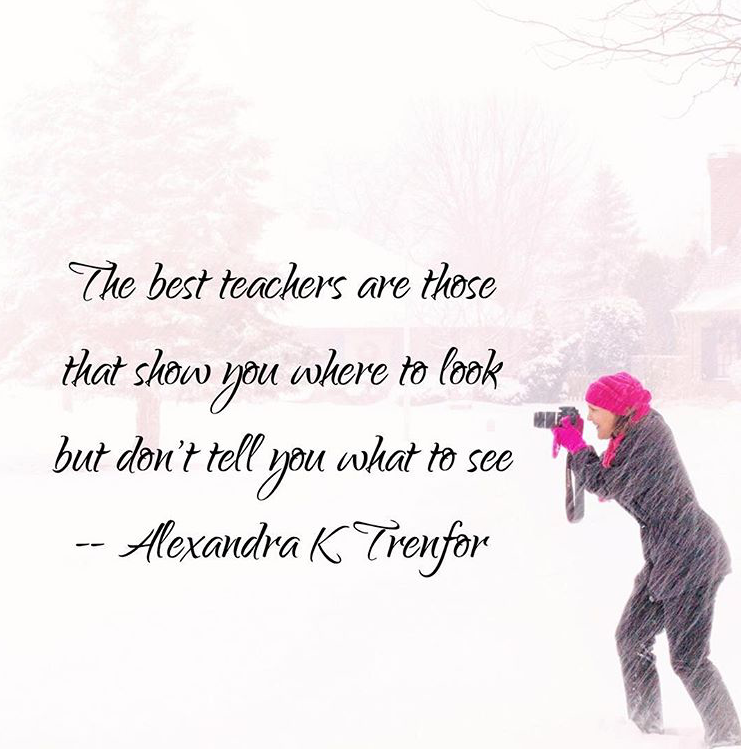
A quote that I have seen over and over on multiple occasion is the one in the image above: "The best teachers are those that show you where to look but don't tell you what to see." It is attributed to Alexandra K. Trenfor. Out of curiosity one day I decided to see who exactly this person was because I felt this little nugget of wisdom was so powerful. Imagine my surprise when not only I could not find anything about the person but found that other people had been on the same search. There is a bit of irony not lost on me that educators on a regular basis repost this quote and put it on educational websites and it can't really even be checked for authenticity. I mean, when I posted it I continued to attribute it to Alexandra K. Trenfor but I don't really know if that's right or not.

That left me thinking about the overwhelming need for curation of information in today's world. When we want to quote a website, oftentimes it is downright impossible to find the correct citing unless one uses an online bibliography that searches it from the URL and sometimes even then we come up empty handed.

Today as I was sick in bed I found myself digging around the internet looking for information on some topics I've been pondering and I came across this video that was uploaded in 2007. It's titled "The Machine is Us/ing Us." It speaks into the fact that WE are the creators of the web by the things we post on a regular basis, like this blog for instance. I am putting information out to a worldwide audience that might sway someone towards or away from a certain way of thinking about education. The "machine" is us but at the same time the machine is using my information, thoughts, and clicks to develop itself further. It's both alarming and intriguing to think of the power every John Q. Public has in the world today.
That being said, how do we as educators guide students to make ethical choices in what they claim as their own information? How do we guide them to best discern what is good information? How do we help them critically think about what they read and to turn information into knowledge? Especially when we ourselves are struggling with it as well. We are bombarded by fake news, wikipedia, and find ourselves searching snopes.com for discernment but I'll be honest some days I still don't know what is real or not (especially in regards to politics lately). We are being manipulated by our clicks as to what "real" is to us and yet we also have access to great information that allows us to learn anything we want to at the typing of a few key words. While we struggle with the shotgun method of information that comes at us regularly we must learn alongside our students how to best manage this resource. I don't want to be seen as a machine but I do want to know that I am adding value to the machine. I want my students to experience that as well. The ubiquity of technology cannot be ignored but it can be used for good.

Wednesday, October 7, 2015

The Beauty of Students Using Mass Emailings


It's digital citizenship month and we tend to be focusing on protecting/preparing/preserving our students' identities from the "bad stuff." But this morning I had this moment that reminded me that students use the power of the Internet for GOOD a lot too.

One of my favorite chuckles when talking to my 16 year old this summer was when she said, "Mom, no one ever uses email anymore." Granted in her world of technology for communication, this is basically correct. She contacts her friends via snapchat, texting, Skype, and FaceTime. As a rule, teenagers don't use email to communicate with each other except when they need to get information to or from a teacher, etc. 

But this morning, my junior daughter that said that this summer was getting ready for school, her uniform was on and she was in my sock drawer looking for red socks. In our community, a neighboring school tragically had a death of an athlete while in the pool. Many schools in our area are showing their support for the family and friends of Sumner Smith by wearing red today (Baylor's school color). I asked her, "are you wearing red for Sumner?" and she said "yes." I said, "I didn't realize our school was doing that today." Her answer was, "I got an email from Hallie-Blair telling everyone to wear it." Hallie-Blair is a student in her grade. This got me thinking...There is also a member of her junior class that sends encouraging Bible verses/devotions out as well. 

We often give our students a bad rap for their inappropriate use of their digital environment but I am thankful for students that use it to change the culture around them for good as well. I'm sure there are other students that have done things like this that I am not aware of but how awesome is it that technology has allowed these nobel-minded students a path to touch the lives of those around them in a positive way in the midst of trial, crisis, or just weekly encouragement?