Wednesday, April 8, 2015

The REAL Digital Divide

I never intended to be on a controversial bandwagon. I didn't mean to teach anything someone could be vehemently opposed to. For years, I naively didn't even imagine that my "helpful tech tips" to fellow co-workers would be seen as anything but useful nuggets to be stored away for future readiness. And then the veil was lifted, the sands started shifting, the rolling of eyes began, and I started tiptoeing.

What in the world did I do, you ask? I went from being the mild-mannered, silo'd computer teacher to harking the benefits of technology integration in all classes and curriculums. I went from "that sweet teacher down in the elementary school that teaches our students really cool computer skills" to "that tech coach that's trying to change the way we've taught."

I'll be honest, it took me 2 1/2 years before I even realized seeing me walk down the hallway made some people feel uneasy. I was that naive. I truly and totally thought every single teacher would see the merits of technology in the classroom, that they would agree with me that it had the ability to revolutionize learning  as we know it. To me, it was a no brainer so when I tell you I was shocked that people were offended by my offering of technology coaching in the classroom this would be a dramatic understatement. 

You hear a lot about the digital divide in education these days- the haves and the have nots. You hear about how the lack of connectivity for some poor and rural students is causing a digital divide in today's world of education and I believe that is true.

 But there is also another digital divide- educators that are adopters/adaptors of educational technology and those that see no use for trendy technology in the classroom to disrupt pedagogy (and of course whenever there are two camps of opposing views, there are those on the spectrum).

Those along the spectrum are the ones I work to show the benefits of how technology can streamline their classroom or add another dimension to their teaching. Those spectrum educators are fun to work with because I love the challenge of helping them. Those early adopters are the ones I say "hey, I heard about this idea, are you ready to take it to the next level?" They are the ones that keep me on my toes and make me research and push myself to never be satisfied with where I am as an instructional technologist. 

But then there are the "naysayers." Some blatantly spit the word "technology" every chance they get, some are more subversive in their approach but regardless of what the technique is, the digital divide happens and the the abyss gets larger and deeper between each camp as the school year progresses. Feelings get hurt, pride gets ruffled, and real meaningful dialogue from both camps happens as well. With any divisive subject (toilet paper dispensed from top or bottom? Pepperoni or cheese? White after Labor Day or not?) things can be learned from both parties if those involved are willing to be open minded in discussions.

I'm not making this stuff up, it's that time a year when my fellow educational technology professionals are lamenting the same things I am. A school year is almost over and sometimes we still feel like we are banging our heads against the wall regarding those we feel are entrenched against what we are striving to do. I hear the angst, disappointment, and struggles in their voices  as we sit around licking our wounds and pulling up each other's boot straps to take on the end of this school year. 

I've learned a lot this year. I feel like I think about educational technology almost to an obsessive degree. Because of this, I have learned better ways to be more diplomatic with the hesitant educators. I've watched lightbulbs go on when I've done a better job explaining the WHY and HOW of technology integration this year. I've gotten a better grasp on it myself- I'm a more confident implementer- I'm much better at adjusting a lesson midstream than I was in the previous two years. I've failed forward- daily. 

I try not to take the anti-technology camp's comments as personal. I find joy in the little successes and share those successes as I can. I work everyday not to become biased and jaded towards others so that it won't affect any opportunity I might have to help them in the future.

As I said, I never intended to ever teach a controversial subject. I never intended to have to justify what I teach on a weekly basis, but not all crusaders choose their path. This blog post comes from a Twitter chat comment I made to someone really discouraged last night with the negativity and refusal to use technology in her school district that she's been dealing with all year. My comment to her (which has become my goal for this school year) was "Be the difference. Be so good at what you do you can't be ignored." It's not an original quote for sure, but it empowers me daily.

For all of you out there on each side of this digital divide fence, if we are all truly striving to be our best and keep our schools "student-centered", I think we will find our happy place for everyone involved. Let's play nice. 

Wednesday, March 18, 2015

EdCamp GigCity Being Hosted By Chattanooga Christian School

On May 9th, Chattanooga Christian School will have the honor of hosting the second annual EdCamp GigCity event for public and private educators to come together from 9-3 for a day of participant-driven learning. The beauty of EdCamps is that it is free to the educator, allows them to be in control of their path of learning for the day, and it gives them a chance to connect with other educators in our city and beyond.

According to www.edcamp.org "Unlike traditional conferences which have schedules set months in advance by the people running the conference, Edcamp has an agenda that’s created by the participants at the start of the event. Instead of one person standing in front of the room talking for an hour, people are encouraged to have discussions and hands-on sessions. Sponsors don’t have their own special sessions or tables, all of the space and time are reserved for the things the people there want to talk about. People could pay hundreds of dollars to attend another conference, or they could go to Edcamp for free."


We are very excited that CCS has been given the opportunity to host the event this year and we are strongly encouraging all local educators (and beyond) to attend. Tickets are now available and educators can sign up for the free event at edcampgigcity.eventbrite.com/?aff=estw. Spread the word!

Sunday, March 15, 2015

How to Be a Well-Connected Human: Digital Citizenship for Adults byguest blogger Samantha Bates

There are a smattering of resources for teaching children how to safely and healthily use the Internet and mobile devices. This is not one of them. This post is for adults.

We’re the ones that children are learning how to interact with using technology. We’re the ones indigenous to the Internet when they create their accounts and get their phone numbers. We’re the ones setting the rules, the culture, and the parameters. Essentially, we’re the reason that digital citizenship lessons are necessary because we’re creating the digital world and digital society.

It’s therefore our responsibility to make it great place to be, and that’s what my post is going to address. But first, a confession.

I hate the term “digital citizenship.”

I’m a millennial. In elementary school, we learned how to interact with others online through this thing called “email”. In middle school, my family got a computer and a modem (and ear plugs), and I got an AOL Instant Messenger screen name (or several, eventually). In high school, I had a LiveJournal diary and a MySpace page, and my family got cell phones. My freshman year of college, Facebook happened.

I cannot fathom a world without online connection and instant communication. I literally can’t even.

This is why the term “digital citizenship” confuses me.  Being a good driver isn’t “roadway citizenship”; being a good employee isn’t “workplace citizenship”; being a good grocery store patron isn’t “supermarket citizenship”. Being online is so normal to me, so natural, that it’s just an extension of who I am. When I’m online, I’m still me. Just online. It’s just another place that I go. When I text, that’s still my voice.

But not everyone thinks this way, and even at times, I have misrepresented who I am and what my principles are. The Internet can be an alternate universe, and if you want to create a completely different identity, that’s within the realm of possibility. “Digital citizenship” and even “netiquette” as terms separate reality (citizenship, etiquette) from the technology when what we really need is more humanity, not less.

When we remember that we are people interacting with other people, our behavior becomes more, well, humane, so here are some helpful things to remember when connecting with others using technology:

Misinterpretation happens.
The majority of communication is nonverbal, meaning that unless you’re video-chatting, most of the way you say what you mean is stripped from your written message. The result? Misinterpretation. It’s just how human brains function; it’s rarely intentional malice (unless you’re reading YouTube comments).

The opposite is also true: when you read something, you might be misinterpreting someone else’s thoughts. The shorter the message, the less context you have. And I’m not even going to describe what autocorrect and autocomplete can do to a rational thought.

Absolute privacy is imaginary.
Last December, Audrey Shores and I did a presentation on Educators and Social Media. In it, we show screenshots of actual tweets and posts that got somebody fired or disciplined. None of those posts still exist, and many of the accounts have been deleted, but the words and ideas will live forever (or however long digital images will exist). Some of them were posts that the person thought were private, or they thought only their friends could see them, or they claimed that the account was satirical.
The truth is that digital communication was created to spread information quickly, even information, files, and images that you don’t want shared. Sometimes we mistakenly publicize something meant for one person; sometimes we reply to all (Thanks, group texts!). Sometimes we text the wrong number. Sometimes we share something with a trusted person or group, then relationships sour, and your thoughts or images are shared without your permission. Sometimes hackers.

Anonymity isn’t for everyone.
There are different reasons for being anonymous online. With our students, we tell them that it’s safer to be anonymous. Also, you can say and do things without repercussion when you’re anonymous, like whistle-blowing. On the flip side, you can say and do things without repercussion when you’re anonymous, like cyberbullying (another term I hate. It’s just bullying.). There must be a balance between freedom and accountability. Before seeking anonymity online, please analyze why it’s so imperative for no one to know who you are. Safety is understandable, but doing and saying terrible things is inexcusable.

Internet safety is for everyone.
In preparing for the webinar, I checked to see how my Facebook page looked from different users, and I was flabbergasted. Anyone I friended had my cell phone number. Perfect acquaintances. Former students. Random mutual friends. I have something like 600 Facebook friends that I’ve amassed over the span of a decade; there’s no way if all those people asked for my phone number I would give it to them, but there it was.

The same applies to using location services. Sometimes an app or site simply shows everyone your city, but sometimes the map gets detailed enough to show your exact location. If you’re using Facebook Messenger from your house, anyone who you message knows where you live. And that’s creepy.

We tell our students and children not to post about being home alone, but when we go on vacation, we tell all of Facebook that our house will be unattended for a specified amount of time.
We tell our students and children not to meet random strangers they meet online, but then we use Craigslist. (A good read: How to Buy and Sell Safely.)
We tell our students and children to report cyberbullying and inappropriate contact, but how often do adults report harassment to site administrators and cell phone providers?

Conclusion
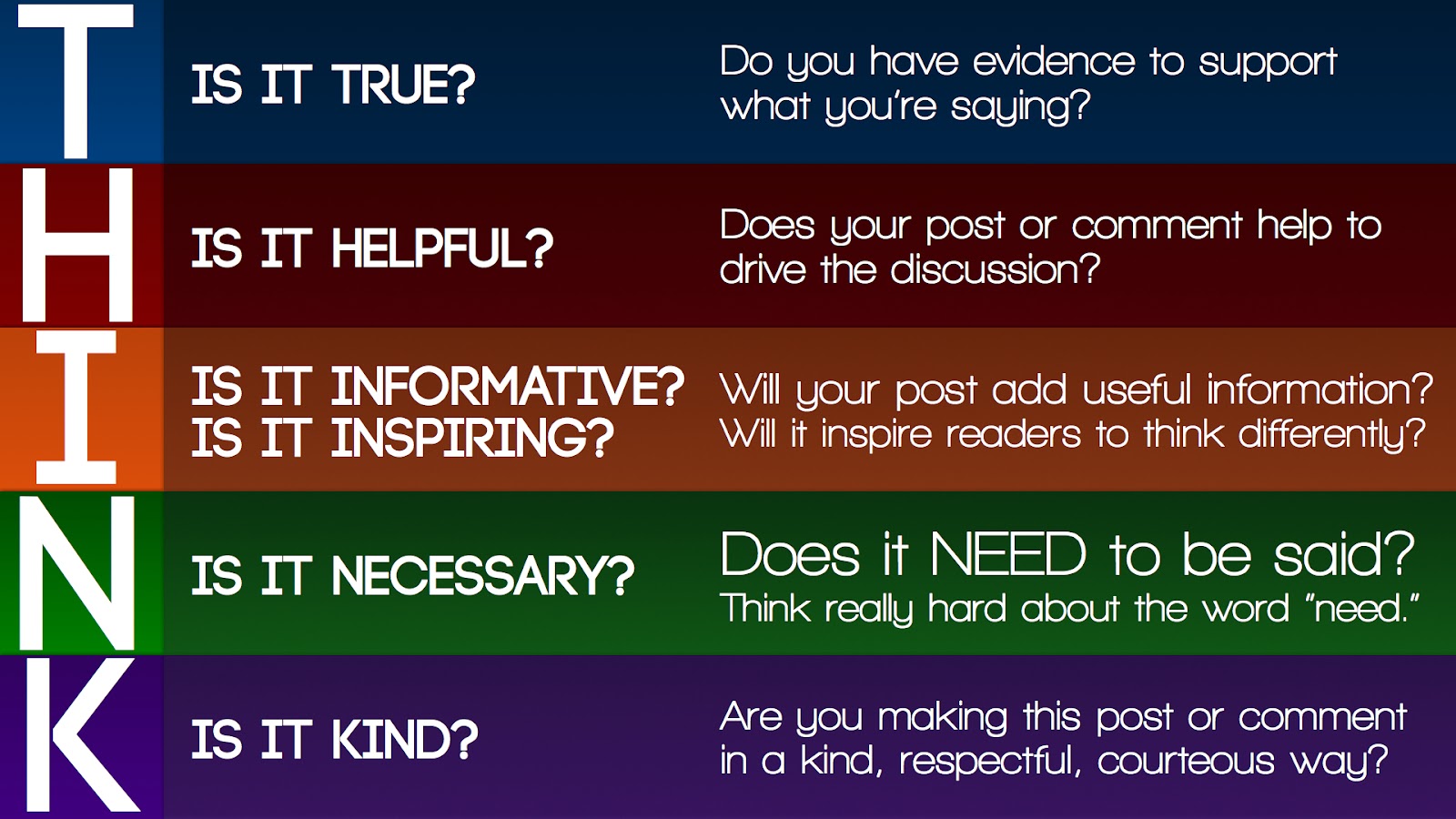
Perhaps our students and children are having such a difficult time being responsible with technology because role models are lacking. Often this isn’t intentional. While it is undeniable and unfortunate that there are adults who take to the Internet to be malicious and inappropriate, there are far more adults who take to the Internet without thinking before posting. I’ll leave you with my favorite resources on citizenship, Flocabulary’s “Oversharing” and this THINK poster:

think.jpg

Samantha Bates is a former middle school teacher and current Director of Member Services for Professional Educators of Tennessee. She enjoys spending time with her family and dancing like a crazy person when no one is watching.

Saturday, February 28, 2015

The 4 C's of Tech Implementation (Part 2 of 2)

                                                                (https://stocksnap.io)

I am a fan of alliteration, and this is part two of a series of posts. The first article was about "The 4 C's of Tech Integration" and can be found here: http://techhelpful.blogspot.com/2015/02/the-4-cs-of-technology-integration.html, in that article I discussed the fact that technology in the classroom can be used for "creation, consumption, curation, and connection."

In this article we will talk about "The 4 C's of Tech Implementation: critical thinking, creativity, communication, and collaboration." In other words, we will be looking at what can happen in the classroom when technology integration is implemented. I do not believe these things ONLY happen in a tech-rich environment, I am just sharing first hand with you what I have seen happen when technology is involved.


  • Critical Thinking- Technology allows teachers and students to dig deeper than they ever have before. Less time has to be spent on facts because the students have the ability to research and CURATE facts quickly and easily. This allows the teacher to be able to ask deeper, "non-googleable" questions to spur more critical thinking. According to dictionary.com, critical thinking is "disciplined thinking that is clear, rational, open-minded, and informed by evidence" (http://dictionary.reference.com/browse/critical+thinking). By allowing students to use technology in the classroom, you open the door to leading them to find information, sift through it, and discern for themselves what they believe the "right" answer would be to any question we ask. We, as teachers, no longer have to be the only the authority in the classroom- the pressure is off. Our students are no longer limited to our view alone due to the enormous amount of information available to them on any given topic via the world wide web. This fact alone gives our students the ability to be critical thinkers more often because they always have to CURATE any information they CONSUME from the Internet.
  • Communication- In the 80's, when I was in school, I would pass notes to my friends in the classroom when the teacher wasn't looking or between classes in the hallways. I think of that stack of notes I had folded in a box under my bed for years. Inside those notes were the latest grade-level gossip, the angst of a teen heart, plans for the weekend, and occasionally even things were discussed having to do with my education. Teens haven't changed, just the mode of communication has changed. Students now have the ability to be CONNECTED 24/7. While there are things about the ability for constant connection that infuriates me as a teacher, I can also see the benefits of it. Due to learning management systems, texting, and email, there is no reason students can't always be "in the know" about homework and lessons. We also now have the ability to communicate with ease with our students and parents more than ever before. It takes a village to raise a child- and the village no longer needs smoke signals to help a student be academically successful. We can CONNECT with each other easily thanks to modern day technology. I would love our school to have a goal to have all teachers at our school k-12 create a lesson plan online that would allow us to have one "snow day" that didn't count against us. In today's world, what a wonderful opportunity that would be, instead of making up days after that beloved day we've been striving towards all year as "the official start of summer."
  • Creativity- Technology changes the dynamics in the way students can recall information back to their teacher. In the past, a three-holed punched booklet with yarn to tie it all together, a poster board, a diorama, a clay model, or a tri-fold display were among the ways students presented learned information to their classes. Now CREATION has more venues: slide presentations, graphic organizers, e-book creations, video presentations, whiteboard app creations, podcasts- all lend themselves to giving the student more options. Students love options in CREATION, and their audience can be the entire world now, not just the teacher of the 23 other kids in their classroom. As teachers, if we give our students a well written rubric, it doesn't matter how the student chooses to present. This freedom is good for the students but it also makes the grading of presentations less tedious for the teacher because every project isn't a cookie-cutter CREATION like the last. The implementation of technology in the classroom allows students to share their uniqueness more than ever before. They are only limited by their own inhibitions. Lately, students have seen the positives of "app-smashing" to create projects to wow their viewers. App smashing  is "the process of using multiple apps in conduction with one another to complete a final task or project" (http://www.techchef4u.com/ipad/thinglink-the-ultimate-app-smasher/).
  • Collaboration- Unlike communication, collaboration is the act of working together to solve or learn. Technology takes the idea of group projects to the next level. No longer are projects confined to the four walls and time constraints of the school day, or even worse...a parents ability to get their student together on the weekend to "finish up that project." With the ability to constantly communicate using technology, students can much more easily work on projects together and hone their skills of becoming a "team player." With the invention of Google drive, students can all collaborate on a document in a shared folder anytime of the day or night. The ability to collaborate using Google Docs has also helped students learn to help each other. For example, students type their first draft of a report, share it with a friend in class, and their friend comments on it, suggests grammar corrections, and marks it up for revisions. This helps both students learn how to discern good writing and hurries the process of the writing assignment itself because the teacher no longer has 24 papers to look at, correct, and hand back. Step one makes for less revisions for the teacher to mark later. Some students are even taking notes in class together in a shared Google doc. What one student hears and adds to the document may have been missed by another, this allows each student the benefit of 3-4 sets of ears to record the "important" things in a lecture. 
By integrating technology in our classrooms, we are seeing an increased benefit of critical thinking skills being honed, communication being ongoing and more likely, creativity being maximized, and lastly, collaboration being able to take place like never before. 

Tuesday, February 24, 2015

The 4 C's of Technology Integration (Part 1 of 2)


If you google "Four C's of Technology Integration" you will get links to a myriad of "C-words" including: Creativity/Creation, Consumption, Curation, Connection, Collaboration, Communication, and Critical Thinking. All of which are important elements of learning and can be enhanced with the use of technology. 

For the sake of this blog, I am going to focus more on what devices themselves can do, so my four C's include:
  • Creation- Allowing students to use technology for creation purposes allows students to tap their creativity juices for presentations of knowledge learned. There are an unending number of ways this can be done via apps and websites (see this spreadsheet for some of my favorites https://docs.google.com/spreadsheets/d/1mbeadniHaSTZDDGh2U5KhqH1KqHiOUdAro0JOyfWDBU/edit?usp=sharing). Opportunities for creation are only limited by the students inability to think creatively and any limitation you as a teacher place on your students. I am a fan of not limiting the students and allowing them to choose how they want to "present." A well written rubric allows a teacher to grade any content in any type of presentation fairly. I prefer one rubric for any presentation styles for a project but Kathy Schrock has a great list of rubrics here http://www.schrockguide.net/assessment-and-rubrics.html that you might find helpful when creating rubrics for yourself.

  • Consumption- Allowing students to use technology to ascertain large amounts of knowledge gets a bum rap at times. When iPads first came out there was a large vocal group of people that said "all you can do on an iPad is consume" and they were developed for consumption but since their inception, app makers have changed and developed how we view devices. I think the educational community has felt the need to stand up for the iPad so much that many have stopped seeing the value of the use of technology for consumption.

    I love the fact that I can read on a device because it is always with me. It is my choice of consumption much of the time, but not always. I also find great value daily of watching Youtube videos to learn more as well. There is great value to me as a teacher and an individual to always have access to information. I even CHOOSE to sometimes read on my iPhone and even create there! There is data out there that says students don't learn as well using a device to read but also some very recent reports that say that isn't always the case. As screen displays continue to improve, I think we will see more and more schools choosing to use e-books and assign work electronically to model to their students the green behavior of a "paper free" classroom. This is a great article that weighs the pros and cons of pixel vs paper (http://www.scientificamerican.com/article/reading-paper-screens/)

  • Curation- According to Beth Kanter, "Content curation is the process of sorting through the vast amounts of content on the web and presenting it in a meaningful and organized way around a specific theme." (http://www.bethkanter.org/content-curation-101/). While Google does this based on factors we may or may not agree with within a simple search, true curation using a device is driven by a person through research. Teaching our students how to sift through all the topical information available to them on the world wide web is a valuable tool. We are at a place where it is harder to ascertain good sources from bad. We are also at a place where it is unclear whose job it actually is to teach a student how to do good web-based research. How does your school teach your students and teachers how to curate? Does your school force students to use educational databases for their research? Do you teach them how to curate using Google? Do you just accept anything as long as it is cited correctly? This is the area I feel I have a lot of room for growth in.

  • Connection- One big advantage to technology is that it allows the teacher not to be the only authority in the classroom anymore. So many teachers are connecting with other teachers, writers, authority figures, and leaders for their students to learn more about the topics addressed in their lesson plans. Whether through FaceTime, hangouts, Skype, e-mail, or Twitter posts, teachers are contacting others to knock down the 4 walls of their classrooms and allow students to see beyond their current worlds. Last year I worked with a sixth grade Eastern Civilization social studies teacher while her students were studying the Philippines. We Skyped with a friend of mine that is a teacher and Philippine nationalist. The students loved it! Another valuable tool is allowing students to connect to each other through collaboration. We see shared notes, allowing students to proofread each other's writing, and group projects taking connectivity to a new level that can only be achieved through the use of technology because of the immediate feedback Google drive allows. 

So this question begs answering..Are you using all the 4 C's of technology integration in your classroom? Do you see the value of all four? Just like we don't want to limit our student's learning, why limit the tools we place in their hands? We have to be careful in finding the balance of the 4 C's that best meets the needs of our students. We have to be careful not to allow technology to become a babysitter; but when used appropriately as an enhancement to learning, technology offers things to our classroom that have never been available to the teaching profession in the past. I find that exciting because I think we are more likely to teach our students to be lifelong learners now more than ever before, partly because access to information and a constant audience is just so ding dang easy now.

My Part Two of this topic will be a future blog discussing the 4 C's  that can be enhance with the use of technology in the classroom:

  • Critical thinking
  • Creativity
  • Communication
  • Collaboration

6 Things We Are Failing To Learn and Teach About Technology


I often hear limits put on technology for educational purposes. For example, "students can't create a report on a phone," "students don't comprehend what they read when they read it on a device," "laptops are a better choice for education than tablets." "iPads shouldn't be used for consumption." All these naysayers forget one thing- times are changing and everyone is different. I've watched my 18 year old type an entire paper on her smartphone and then open it up on another device to tweak it. When I asked "why?" her response was "I can text faster than I can type." The path of learning is always changing and our current students are growing up in an age where technology has been and will be the way they continue to choose to learn. We should never want to limit a student in their desire to learn and we shouldn't limit how they choose to use that technology if it aids their learning. 

Some of the limitations I hear placed on technology has to do with the speaker's own perceptions, strengths, and comfort level regarding technology itself. What I am saying here is that every person is different and today's students might just prefer technology-based instruction using all of the 4 C's (curation, consumption, connection, creation), or they might not. I do believe we have a responsibility to help them navigate and learn what works best for them. We have a responsibility to open their eyes to different ways to use technology for learning. In order for educators to fulfill that responsibility, we have to see it as our role as well.

The U.S. Department of Education has a big push right now through the Office of Educational Technology to get our students "Future Ready." Their futures will be technology rich. The Internet will no longer be something you check a few times a day, current students will always have the opportunity to be living in a 24/7 connected world. As wearable technology keeps evolving, the price point will keep decreasing, and technology will become less optional. So how do we, as educators, prepare our students for that type of life?

I see schools integrating technology into the curriculum to give students good usage skills. I see with that, students viewing technology as more than just a place to play games or access social media. I see schools believing in and teaching good digital citizenship lessons. I also believe there are some things we aren't doing that we need to take more seriously. Below is a list of things I think we need to constantly address with our students and children:


  1. Technology is disruptive. When students stay signed into their social media and allow notifications to "contact" them on their devices, they are asking for trouble. When your technology is calling out to you all day long while you are in the classroom, it becomes very hard to ignore it. Even if you don't check your technology, your thought processes change from whatever you were learning to wondering what it is you are missing- concentration is broken, attention span is shortened, learning becomes fragmented. Students should do themselves, their grades, their educator, and their parents a favor and disconnect from the personal uses of technology and use their device as an educational tool while at school. I suggest that everyone try it for a short amount of time (not hours- week/weeks) and see if they don't feel more connected to their learning.
  2. Switch-tasking is a thief. People have been multi-tasking for years- TV on, radio on, in a noisy area- trying to study. Some people can do it, but most people don't do it well. The problem is that those same "most people" think multi-tasking doesn't affect them. One of my favorite ways to show people the harm switch-tasking has on their concentration is to follow the steps in this video: http://youtu.be/BCeGKxz3Q8Q. We tend to realize switch-tasking affects us but this video gives us a more concrete way to see just how much it steals from our thought processing. In today's world, it is almost habit to check our phones regularly. Being intentional about not switch-tasking has to be a conscientious act. We should be "testing" our students to see what switch-tasking does to them so that they can learn how they best learn.
  3. Limiting yourself is not bad. We are a gluttonous society. We want all that we can have and then we want an extra helping. Students are the same way about technology. By teaching students the disadvantages of disruptive technology and switch-tasking, we also can help them to see that they can set self-imposed sanctions regarding how much technology they use a day. There are time-tracking apps out there to start analyzing just how much time you are surrendering to technology. There are apps and software that parents (or students themselves) can put on their devices to not only see where their students are spending their time but also limit accessibility time all together. We, as educators, have a responsibility to help the student that struggles with overuse and potential addiction problems. We should be watching and meeting, analyzing and encouraging students to see what their kryptonite is regarding technology usage. We should be offering ideas to help them avoid pitfalls. We should be suggesting accountability partners for those that struggle. We should be telling parents about ways to limit device usage (see Curbi Parental Controls for iOS), other than just the plain old every day discipline of taking a device away or sitting beside a student while they use technology (by the way, these two things are the best way to be proactive with our children).
  4. Unplugging has advantages. We know that not all lessons are better with use of technology. We all know that face to face dialogue where you can read body language, nuances, and tone makes for more understandable communication. We not only know that technology has limits but we know that a beautiful day should beckon us to come explore, that the TV should be shut off, that video games should be ignored, and that the people in our lives should be invested in face to face. We have a responsibility to force kids to see the world beyond their devices because sometimes demanding is what it takes. I'm not talking about "I don't want you using technology in my classroom, period." I'm talking about, "today we are not using devices because this lesson calls for something different." By taking those moments, we teach our children the benefit of talking to friends without those distractions in their social life as well. We teach them that "phones away at the supper table" isn't because their parents are mean, but because their parents want to know them. We teach them that certain conversations, topics, and people are best addressed without a device and there is value in learning that.
  5. Relevance is relevant. Deep, huh? But how often have you been having a conversation with someone and they are also doing something on their phone and you realize they haven't been listening at all? I'm guilty of being that person, especially with my own children sadly, but I know what it feels like to be the one being ignored. Teaching our students to "be in the moment" is a critical life skill. Technology has caused rudeness. We have a responsibility in teaching our students when phone checking is appropriate and when it isn't. We also have the responsibility to teach them, by example (talking to myself here), to be all in when communicating face to face.
  6. Bad tech choices will bite back. I believe beyond a shadow of a doubt that the elementary students I teach now will have their digital footprint traced deeply when looking for jobs when they get out of college. I think there will be footprint tracing companies that other companies will call when they are looking at a candidate for a job and they will look at the posts on social media, photos on the web, comments by googling a name, etc to give those companies an idea of what type of person their candidate is. These tracing companies will give them ideas on their character, work ethic, and stability based on things posted in their past. I believe this will happen because it is already happening on a smaller scale with many employers doing their own searches now. Someone will monopolize on this "need" and it will just be one more step in the process of being hired. What we know about the ease of tracing a digital footprint is only going to get more precise. We must prepare our students for this world.
As a technology integrationist, I see the benefits of technology in the classroom daily but I also see things we need to be doing better. Improving my teaching in these areas improves my students for their future. I owe it to my students to share these things with them as I see patterns developing. Educational technology integration is always morphing and new things enter our realm constantly. We must always adapt, react, accept, challenge, and weigh to best meet the needs of our students academic success.


Monday, February 16, 2015

How Does Excitement for Edtech Become Contagious?

Have you ever been to a sporting event and for whatever reason the crowd just wasn't into it? Maybe it was too hot, or too cold, or the score was a runaway, there wasn't enough excitement, or both teams played lackluster which caused the fans to be chatting in the stands or playing with their phones or people watching more than they were actually watching the event they had paid money to attend. I have been at those events. As a coach, player, cheerleader, rabid fan, or sports administration person the overall thought has to be "How do we change this climate?"
The same concept often holds true in education regarding technology. There are educators out there doing amazing things by using technology to enhance lesson plans but they aren't being seen, applauded, or even recognized! There is a new teacher out there- the one that realizes times are changing and constant access to information is here and  affordable wearable technology is right around the corner. According to a 2014 Pew report 83% of Americans aged 18-29 have smartphones. While this study did not ask anyone under that age, I know as a mother of teens, in my school community, the percentage of teens with smartphones would be exceptionally high as well (http://www.pewinternet.org/fact-sheets/mobile-technology-fact-sheet/).  There are teachers out there that are now trying to adjust their teaching to ask more "ungoogleable" questions, to change their teaching into "how do I teach these students to love learning, critically think, curate information, and use the information they always have in hand to make them smarter, well-rounded, individuals that add to, develop, and influence their worlds around them for good?" It's a question educators have been asking for years, "How do I best teach my students?" but the difference is that today's student has access to information on them all the time. According to my google search just now, "Google now processes over 40,000 search queries every second on average, which translates to over 3.5 billion searches per day and 1.2 trillion searches per year worldwide." (http://www.internetlivestats.com/google-search-statistics/). This tells me that people want to learn and are learning everyday in their least restrictive environment.
So why is it some educators just don't see the value of teaching students using technology? WE NEED MORE HYPE. No, not hype for hype sake...but teachers need to see how to make a good lesson better or a bad lesson good! Three times this year I have taken groups of educators to different schools and let them observe technology integration in action. Three times this year, those teachers have come back to our school and implemented something they were excited about seeing while at those schools. When teachers see amazing lesson plans using technology working, they feel more confident that it will work for them. When teachers visit enthusiastic tech-using teachers, when they have enthusiastic tech support, when they are praised by their administration for trying to enhance lessons using technology integration, when they have small triumphs they want to share with others, the excitement for Edtech becomes contagious. What can we do to grow this? Encourage teachers to ask others how they are integrating, encourage great integrators to share their ideas, allow teachers to visit other schools, give them the support staff to brainstorm new ideas, give them the culture to fail forward, hold their hands, invest, research with and for them. We need to celebrate beneficial edtech moments in their classroom and push them through the failures and fears of bad tech moments- both happen, just like good and bad lesson plans happen without technology. Visiting a teacher that is smiling from ear to ear because they have come to the realization that something about edtech makes them feel like they can "teach" or "reach" better is one of my favorite moments...those smiles are contagious- share them!