Friday, August 16, 2013

Digital Citizenship Toolbox

For the next two weeks I will be going into the elementary classrooms and discussing "digital citizenship" with our students. In some classes we will watch video clips regarding leaving a digital footprint, in the older grades we will actually go over the school's adopted Technology Community Covenant (https://docs.google.com/a/ccsk12.com/document/d/1DijPZBqqt13o2WuEfyKd3gw3adrUeT1qXf-cFG5kp-I/edit) and have them take it home to their parents to discuss and sign as a family. The depth and scope of my discussions about digital citizenship varies due to age of the students but doing this in the first 2 weeks of school is something that I feel very passionate about in my teaching.

In every grade level I will be sharing my class Bible verse of the year to serve as a guide for them when they are on the Internet, (Philippians 4:8 - Finally, brethren, whatever is true, whatever is honorable, whatever is right, whatever is pure, whatever is lovely, whatever is of good repute, if there is any excellence and if anything worthy of praise, dwell on these things.)  Lastly, each grade level will be shown my DIGITAL CITIZENSHIP TOOLBOX adapted from this blog post on Comfortably 2.0. Below is my version that I will be sharing with the students:

Digital Citizenship Toolbox


Credit Card
Give and get credit. We’re all proud of what we create. Illegal downloading, digital cheating, and cutting and pasting other people’s stuff may be easy, but that doesn’t make it right. You have the responsibility to respect other people’s creative work -- and the right to have your own work respected.


Padlock
"Lock 'em down.” The padlock is to remind students to set strong passwords and to set up passcode locks on all of their digital devices.   


Toothbrush
I tell students to think that passwords and toothbrushes are very similar in the fact that you NEVER want to share passwords.  (I do highly encourage/recommend that students to share passwords with parents)


Permanent Marker
Everything that you put online is permanent....even if you hit the delete button after posting.  Odds are someone has retweeted, favorited,  or taken a screenshot of the material if it was questionable.  


Toothpaste
Imagine the information that you are putting online is like the toothpaste coming out of the tube.  Once it is out, it is almost impossible to get it all back in the tube!  


Yarn
Tangled web we weave. If you want your privacy respected, respect others' privacy. Posting an embarrassing photo or forwarding a friend’s private text without asking can cause unintended hurt or damage to others.
Spreader
Spread heart, not hurt. If you wouldn’t say it in person, don’t say it online. Stand up for those who are bullied or harassed, and let them know that you’re there for them.

Make this a world you want to live in. Spread the good stuff. Create, share, tag, comment, and contribute to the online world in positive ways.


Monday, August 12, 2013

Do you know what social media sites your students are using? a.k.a- Hatin on Facebook

I am not normal. There, I said it...I am sure you have been suspecting it for months but I thought we should just talk about the elephant in the room and get it out there. Now, shall we talk specifically about what "not normal" thing about me I am willing to discuss with you this evening...

Even though I am 44 years old, I have been on Facebook since 2005...back when the only people on Facebook were college students. For me, I was working on my masters in Instructional Technology so I did not exactly fit the "mold" of Facebook users, but I was onboard. I was mainly on board because I was an Instructional Technology person wondering what all the hub-bub was about. So I will have to admit, as Facebook opened the door for any Tom, Dick, or Harry to join, I did NOT like it (that was what MySpace was for!). I enjoyed the exclusivity of Facebook. I enjoyed the simpleness of it. I enjoyed having a place to vent that my momma would not see and call me to ask "What is wrong? What is going on?" So it does not surprise me to to read this article where a  13 year old explains why teens don't like Facebook. I get it...I get that it seems like Facebook tried to hard and I get that teens do not like it when they sense someone tries to hard. I get that they want their own place for communication. Fortunately for me, my momma does not tweet...YET.

BUT, it also made me stop and think. What social media sites are our students choosing now? Twitter, Vine, Instagram, Ask.fm, YouTube, Tumbler, SnapChat...and the list goes on and on. Not only are there lots of choices, but it actually seems like some "schools" prefer some sites more than others, some age groups within teens prefer some sites over others, and what is THE BEST one day, may not be the best the next day. (For example, my own teens were on Vine all the time, Instagram enters the picture creating the ability to video and now they rarely Vine. That is not always the case but for my kids: One day Vine is hot, the next day it is not.)

What does it matter? I feel like as a school body we have a responsibility to teach our students to be responsible on these sites but we also have a responsibility to help parents stay "in the know." Not every parent has the time to navigate #edtech and #socialmedia hashtags to read the latest breaking news. (Oddly to me, there are few parents that find joy in all this like I do.) <---Read sarcastically.

So how do we do this? At our school we are creating a "tech council" comprised of students, teachers, administrators and parents for discussions on subject matter like social media and other issues regarding technology and education. I am excited about this! For me, right now it is fairly easy to see what is "trending" at our school because I have two high school students...but it will not always be that way. Someone else will have to tell me what their kids downloaded last night. This will be a great way for our school to not only stay aware of the latest, greatest technology app but it will also allow for open dialogue and communication in how it effects all of us at every age level.

My "mantra" for this year has been "PROACTIVE NOT REACTIVE." I think this tech council is a step in the right direction to keep us in that mindset.

Saturday, August 10, 2013

You are more like your students than you think...Training reflections from a sassy techie

After spending a few days training teachers regarding educational technology I came to the conclusion that we, as teachers, are often more like our students than we realize.
  • Some of the teachers were digital immigrants (born before the 1960s), some teachers were digital natives (born after 1960s)...but age was not always an indicator of ease of use with technology.
  • Some teachers were feeling unprepared for the school year and the technology being used.
  • Some teachers were excited about the technology efficiencies they can experience.
  • Some teachers were overwhelmed with information overload.
  • Some teachers were using their technology (phones, laptops, iPads) to be off-task during my presentations.
  • Some teachers felt that they had a gazillion better things to do than listen to what I had to say and suggest.
  • Some teachers hung onto my every word and were researching things I said during my presentation or creating their first form before the 50 minutes was up.
  • Some teachers were busy chatting with the person next to them...sometimes about the presentation and sometimes about what was for lunch.
  • Some teachers were talking under their breath about how they wouldn't be using the ideas I suggested.
  • Some teachers thought they already knew everything about the subject area and this was a waste of their time.
  • Some teachers felt scared by the technology and worried they won't be able to get on board like they should.
  • Some teachers were combative about some of the decisions regarding app and software decisions made by the school.
  • Some teachers were grateful for the ideas.
  • Some teachers were tired from full days of "learning."
  • Some teachers were just waiting for the 50 minutes to be up.
  • Some teachers wanted help after class.

So I walked away from these meetings thinking:

  1. We do the things we complain about regarding our students when we are "students." 
  2. We must model good digital citizenship if we expect our students to be good digital citizens.
  3. In every classroom we have both confident and petrified students.

I leave you with these thoughts:
As this school year progresses, remember what your actions and the actions of the adults around you looked like during in-service. Perhaps this means we need to make our lessons more engaging. Perhaps it means we need to meet one-on-one with the student with a sour look on their face to ascertain what is REALLY going on with this kid. Perhaps it means we need to be more supportive. Perhaps it means occasionally we are all off task and feel exhausted from learning ALL. DAY. LONG...You are more like your students than you think and this is a perfect time for that realization to hit you. Let it sink in, it might just make you a more compassionate teacher for this coming year.


Saturday, July 27, 2013

Rules of Engagement for BackChanneling

If you are unfamiliar with what back channeling is, take a look at this link http://net.educause.edu/ir/library/pdf/eli7057.pdf. I see many benefits in using back channeling to allow questions to be answered that might not be addressed by a speaker/presenter. It allows the shy student to be able to feel more confident in question asking, it allows the thought of the meetings to go deeper for those already familiar with the topic, as well as serving as a way to answer the questions of those that feel "this is all Greek to me" because they can communicate with their peers immediately and get caught up in the conversation.

All that being said, lately I have seen and been on the receiving side of poor digital citizenship skills. An inconsiderate backchannel participate has great power with this tool. When things are said in an attacking nature or judgmental view, backchanneling can go from being a resource with positive results to making the speaker want to ball up in a corner sucking their thumb in the fetal position.

Since no one wants to see that, here is my attempt at some suggested Rules of Engagement for BackChanneling. Some of these may seem like common sense, but after my week I feel the need to make this as simplified as possible.

1. Make sure whatever you would type in the thread is something you would say face to face to that speaker.
2. Passionate feelings are not bad but make sure if you disagree you are doing it in a constructive way. Constructive criticism helps us grow, it is still painful, but by using BackChanneling we are saying "Hey, I would like your thoughts on this." Be sure not to ATTACK THE SPEAKER AND FOCUS ON THE IDEAS BEING PRESENTED.
3. Use a moderator in case things get off track. This does not have to be prior planned. Just ask someone if they would be willing to "police" the conversation and gently guide the responses back to the appropriate topics. Not all speakers follow the BackChanneling while they speak, so this can be a great help to the speaker.
4. Resist the urge to turn a thought into an ongoing conversation that becomes silly, stay professional. This becomes a distraction to others and shows disrespect to the speaker by your "hijacking" of the event.
5. If you adamantly disagree with something that is being said, think of the immortal words of Thumper, "If you can\'t say something nice...don\'t say nothing at all." Save your thoughts for after the presentation and go speak directly to the speaker. This allows facial expressions and the emotion behind the thoughts to be expressed.

Thursday, July 25, 2013

When Great Technology Tools Are Used Irresponsibly-Digital Citizenship Importance

Today I had the opportunity to go to a conference with 450 educators from across the country to learn more about technology in the field of education. Today I also had the opportunity to see the importance of good digital citizenship skills first hand.

It just so happens that I was participating in a workshop held by the keynote speaker after she talked to the masses. During the keynote she used TodaysMeet to allow back channeling during her address. I watched as she opened the dialogue up and saw the posts made by the audience. I also watch her become deflated by some rude and negative remarks. She was shocked at some of the responses (including put-downs of her dress...really?!) but handled it like a trooper. Her answer was, "well that's ok, it is out there to allow the audience to work out what they are seeing and hearing." My response was, "No, it's really NOT ok. It is bad form and gave very little constructive feedback and was a poor showing of digital citizenship."  I stand firm on my feelings regarding this and have been thinking about it all evening. I would like to share a few of my thoughts:


  1. Today's issues just goes to show that teaching Digital Citizenship is vital to good technology usage. We can't expect our students to be good digital citizens if we are not modeling it ourselves. 
  2. I wonder if those comments would have been said to the speaker's face? How often do we "hide behind the technology" and allow ourselves to use poor manners?
  3. I see the benefits of using someone to be a "moderator" anytime you are using back channeling. This would allow for some "policing" of the threads and prevent off task and inappropriate talk. The speaker said she had NEVER had that happen before...wow Atlanta, way to go! 
  4. From now on I will be very clear about what is and what is not acceptable before using back channeling with a group. (Suggested Rules for BackChanneling coming soon).
  5. We, as educators, often jump at a chance to use new technology in the classroom but we don't prepare our "students" (in this case, teachers that should have known better) on how to properly use the technology. Educators get stuck on "we aren't teaching the technology, it's just a tool" but I believe this shows we have responsibilities to teach both the content AND the technology.
This speaker handled the situation as a learning experience for herself but I have no doubt she did not leave with a positive view of that group. Being in the South and from the South myself, I would assume that the audience would have been more gentile. I was embarrassed by the feed....Bless their hearts! ;)
(stepping off soapbox)

Wednesday, July 10, 2013

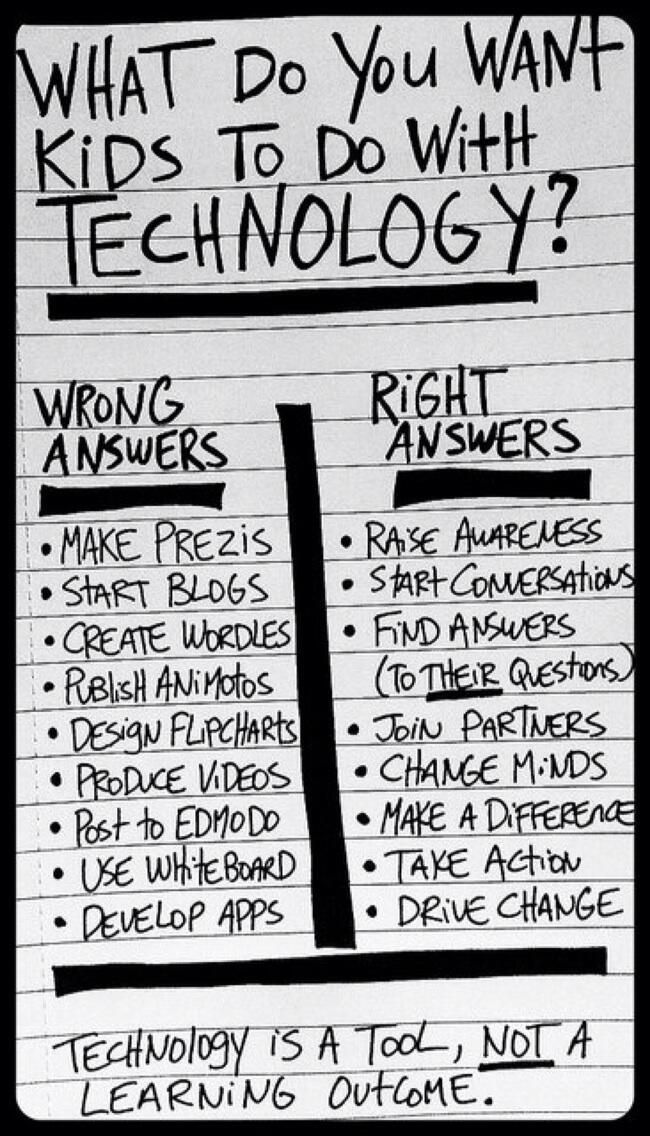
Why this T-model chaffs me just a bit...


I keep seeing this posted on twitter over and over again and while I agree with it's broad concept, the business education technology teacher in me also gets a little undone by it; So much so that it wakes me up at night and causes me to fear we are going backwards! Please allow me to share..

First, I believe technology is a tool, not a learning outcome. I believe technology is what oils a lesson plan for greatness. I believe technology allows students to delve deeper, dream bigger, and research easier. I can't even begin to explain the excitement I have had about seeing what I "teach" become part of the every day curriculum. BUT...

The model above scares me just a bit. Why does mobile learning have to have a RIGHT AND WRONG approach? The truth is, at some point someone has to teach these students how to navigate and use prezi, blog responsibly, access Wordle sites, etc. That is why I find the above model scary.

Technology in the schools has come a long way baby...for years, I have taught a set curriculum that said my students needed to know how to create PowerPoints, save files, etc. All these standards have been VERY specific to meet the ISTE standards and to equip my students for the future. The sad part is that often I have "created" lesson plans that had nothing to do with authentic learning just so I could put a check mark by a standard that need to be met. 

I have been BEYOND excited that this is changing...I now work with teachers to meet my standards but the students are working on projects that mean something to them, something they are studying in class already. It has become authentic learning and is morphing into true learning of technology that just happens flawlessly. This next year I will be in the classroom while a teacher teaches content and I work the room while student pick their app/website/output of choice to show, learn, create, or "take action." 

As this shift happens, there will be less me and more or students just doing what comes naturally, BUT... we cannot forget the fact that standards for technology still exist. Curriculum in ed tech still has to be "taught." When we don't teach that tools have rules and that there are proper ways for creating we undermine the role of technology and we do not show the students the pros and cons to the power at their fingertips. 

I have felt like we, as an educational community, were heading to a place where technology would just seamlessly take place in the classroom and that less time would have to be taught "teaching" the technology...and that is a good thing! BUT...we have to also make sure the teachers take seriously their responsibility to help their students become good digital citizens AND teach them how to create WORTHY output. 

Now I will step down from my soapbox. ;)


Sunday, July 7, 2013

Why Are We Afraid to Manage Misuse of BYODs?

I push around a cart of iPads to elementary students. The cart and iPads belong to the school. If a student disobeys the rules regarding iPad usage, there is immediate feedback to that student. I have been made aware of many teachers not feeling comfortable with managing misuse of devices in a BYOD environment. To be honest, in the beginning it baffled me but I tend to be on the side of a strict disciplinarian teacher instead of relaxed; I also teach elementary students which makes discipline easier (in my opinion).

So these thoughts have been mulling around in my mind:
a) Are the teachers that feel uncomfortable managing misuse the same teachers that feel uncomfortable with discipline as a whole?
b) Are these teachers the type that want to have positive friendships with their students and therefore feel uncomfortable changing the dynamics this way?
c) Is there a way for these types of teachers to feel more comfortable with technology in the classroom?
d) Isn't discipline something we MUST take on when we decide to be a teacher (might be stepping on some toes here)?
e)  Can we assist teachers in this area to help them?

There is a fine line that we as educators walk when interacting with our students. We know that if we are seen as a "tyrant" teacher, our students will shut down and not listen to us at all. We know if we are too soft, they will run all over us. As much as I love a very "fun-based" lesson, I also know some students have a hard time finding the balance between the "silly" and continuing to learn in the more relaxed environment. I get the struggle...as a mother of teens, I live that movie as well.

Here is my fear if we DO NOT remain consistent across the board in our discipline of BYOD:
a) Students will see the school's inconsistency and think that the rules are fluid and flexible.
b) Students will sense the fear of the teachers (or see their desire to look the other way) and not see why we have those rules in place.
c) These teachers that seem so easy-going all the time eventually have their "boiling point" and out of nowhere they have a day in class where they snap and get fed up with the misuse because after a while even the rule-follower students start seeing there are no repercussions for breaking the rules. Then the students are like, "What's up with Mrs. Davis today?"  Our hypocrisy will be eaten for lunch.


So what do we do?
We have to be engaging in our lessons, we have to set limits from day one, we have to move around our classrooms and challenge the students that seem to be off-task by giving them a technology-based task. "Jessica, did you hear that term I just said? "Digital literacy," please look it up on www.webopedia.com right now and tell the class what the definition is." We have in that one statement, brought Jessica back into the classroom discussion and allowed her to use the technology in her hand.

We must remain consistent across the board because students need boundaries and teachers accomplish much when students remain within these boundaries. Does this mean we ban twitter, vine, or other social media? No, it means it is to be used as the teacher sees fit in the classroom but not opened if it has not been teacher directed. See my earlier post http://techhelpful.blogspot.com/2013/06/the-struggle-is-real-equipping-teachers.html  for helpfulness on how to manage and set standards up front for you and your students.

Will it be easy?
Not always. Every lesson plan that I teach has varying degrees of responsiveness and qualities of engagement. I do believe it can be managed and the main thing is, we must not give up. As the new school year begins we must pinky promise each other that we will remain firm in our resolve to deal head-on with misuse of technology. We must work to be engaging. Our focus is not the technology, if we have to constantly deal with misuse, the lesson plan is lost. The technology should be what lubricates the lesson and makes it more fluid. We have to remember that the classroom is ours, and even though that device belongs to the student and their family, you have a right to expect proper use while it is in your classroom.

If a student was poking another student with a pencil during instruction time or throwing a pencil across the room at you when you were writing on the whiteboard, you would take the pencil and respond to the actions. The pencil belongs to the student just like the device does. Misuse is misuse and there are different degrees of misuse that you will have to deal with in the classroom.

How will you revamp your lessons to best meet the needs of your students now that you have the blessing of technology in your classroom?